

The combination of increasingly chaotic times and the tsunami of AI-generated slop means that our attention has never been under greater assault. There are some forms of information that actively diminish your consciousness and agency, and others that increase it. The wisdom to discern the difference is becoming one of the most critical skills of our times.
Borrowing a framework from Peter Limberger and Scott Britton, I think you can roughly sort the content you consume into four quadrants.
Low Agency/Low Consciousness
High Agency/Low Consciousness
High Consciousness/Low Agency
High Consciousness/High Agency
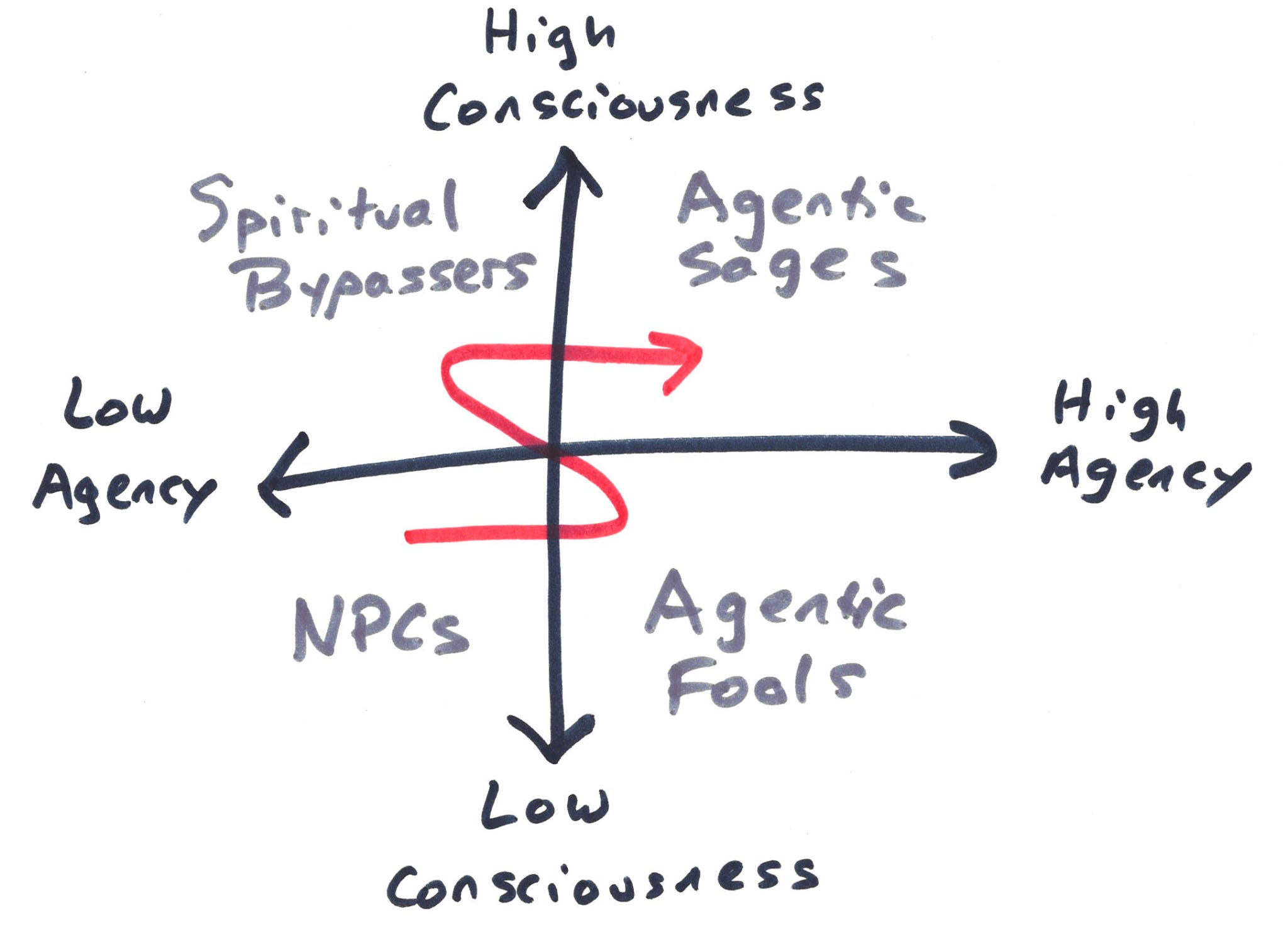
A couple of quick caveats. I don’t like the description higher and lower consciousness. The awkward truth is that some people are definitely further along the path, but I prefer the term “more integrated” rather than higher. Seeing consciousness as a hierarchy to climb is itself a sign of less integrated consciousness. I also don’t love the terms NPC, Agentic Fool or Spiritual Bypasser. One of the key things you learn about developmental models is we all probably have to pass through each quadrant sequentially. So by looking down on any stage we risk unhealthily repressing it in ourselves. That said, the red arrow trajectory that Scott Britton drew through the quadrants is a really helpful shorthand that has been reflected by my own interests over the last twenty years of my life. [Links below are a relevant interview or article of mine].
Low Agency/Low Consciousness: While I find the video game term Non-Player Character (NPC) unpleasantly dehumanising, I’d broadly class “NPC content” as politics, news, celebrity gossip and sports. And I say this as someone who spends roughly twenty percent of his time either watching or reading about Premiership soccer. So why is it “Low Agency/Low Consciousness” content? Because, at its worst, it degrades your consciousness by forcing you into binary thinking and unpleasant emotional states like fear, jealousy or anger. The persistent negativity bias can also reduce your agency by making you feel helpless and nihilistic. The combination of AI slop, deepfakes and global chaos is making this quadrant increasingly uninhabitable.
High Agency/Low Consciousness: In my twenties and early thirties I was mostly drawn to information that would make me more materially successful. As I worked on Wall Street, this was investment research and macro and thematic trends. I then became interested in mental models, cognitive biases, Buffett and Munger. Around 2015, I became drawn to rationalist, big picture thinkers like Tim Urban, Yuval Noah Harari and Scott Alexander. Sam Harris then opened me up to meditation and the topic of consciousness.
High Consciousness/Low Agency: The first significant turning point for me, like many others, was the emergence of Jordan Peterson in 2016. For all his faults, his focus on the transcendent, mythic and psychological led me to Carl Jung and Joseph Campbell, both of whom changed my entire perspective. My central takeaway was that there are hidden, but very real, forces driving the evolution of our consciousness.
In 2017, these explorations culminated in an explosive and destabilising frame break in the form of an awakening experience. This is when I would say I became high(er) consciousness and low agency. I became interested in Eckhart Tolle, Alan Watts and Michael Singer, but personally struggled to integrate their insights into my daily life.
High Consciousness/High Agency: Over the next eight years I regained a degree of personal agency as I gradually reintegrated science and spirituality. The second pivotal moment in my journey was the discovery of Iain McGilchrist’s work in 2020. He was the first thinker I encountered who had a robustly-researched neuroscientific model that could explain much of the world, but without denying the mysteries of spirituality. It also increased my agency because it inspired a year of research into how to become more hemispherically balanced in real life. This increasingly leads to being able to do the right thing, at the right time: the definition of the Agentic Sage.
McGilchrist led me next to cognitive science and the work of John Vervaeke. Then to those pioneers synthesizing science and spirituality like Mona Sobhani, Julia Mossbridge and Ervin Laszlo.
I then learned that this leading edge science resonated with mystical frameworks such as those found in Kyriakos Markides’ books on the modern Cypriot Christian mystic Daskalos, classical and historical research from Peter Kingsley, Greek-Armenian mystic Gurdjieff’s Fourth Way and even esoteric channeled material like the Law of One.
As these explorations continued, I started to realise how critical it was to understand “stages models”: the process of consciousness evolution itself. This led me to return to Ken Wilber’s integral frameworks and explore Don Beck’s Spiral Dynamics and Tara Springett’s Stairway to Heaven. My series of conversations with Brian Whetten also helped raise my awareness of the many pitfalls along this path.
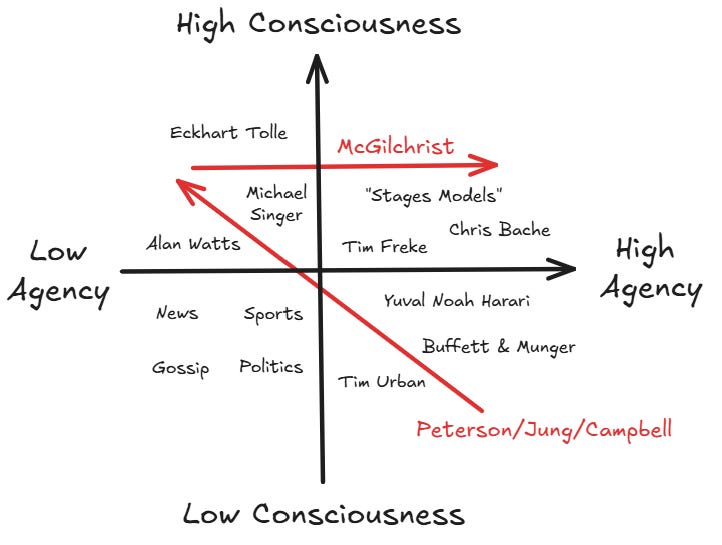
These quadrants represent my own personal journey, not necessarily any negative judgement on the thinkers themselves. Any consciousness journey is subject to accusations of cherry-picking and recency bias. But also the teacher appears when we’re ready, we can then integrate their insights and move on. Moreover, like stages models, these content types build on themselves sequentially. As with most things, it’s a holarchy not a hierarchy. It’s hard to be materially successful without a basic understanding of what’s happening in the world. It’s then easier to focus on deliberately evolving your consciousness after your basic economic needs have been met. This balance then provides the foundation to use your skills and resources in a positive-sum way.
Where next?
I’m obviously not calling myself an “Agentic Sage”, but I am definitely powerfully drawn to people that might help me along that path. These have been thinkers who are offering entirely fresh worldviews that place consciousness and agency at their heart. While their perspectives are consistent with ancient spiritual traditions like Taoism, Buddhism and Christianity, they are also equally comfortable with the analytical power provided by emerging science.
For example, while I naturally find points of disagreement with both, Tim Freke and Chris Bache have been two of the most electrifying thinkers in the agentic sage space.
The author of 35 books on mysticism and spirituality, Freke has devised a “unividual” worldview that describes the current emergence of high agency/high consciousness people. A key distinction between NPC content and Agentic Sage content is the capacity to see beyond binaries and hold paradox. There is an elegance in Freke’s framing: the unividual is defined precisely by their ability to grasp the paradox of being a unividual at all. A unividual is both highly individually differentiated and totally integrated into the whole. Freke’s worldview and meditations are fundamentally relational, and offer one of the most immediate and accessible forms of emergent human experience. One exercise involves sitting face-to-face and directly sensing how you are both utterly unique and yet fundamentally one with the other person. Our closest relationships therefore become the primary training ground for the realization of Freke’s worldview.
Dr. Chris Bache is best known for his remarkable 2019 book LSD and the Mind of the Universe. It relates his insights and experiences from 73 therapeutically-structured, massive-dose LSD sessions over the 20 years from 1979-1999. Our Leading Edge interview with Bache is the most popular one we’ve ever done. He has developed an extremely robust framework for the structure of the universe and the evolution of consciousness, derived from surely one of the most intense psychonautic journeys a human has ever undertaken. It culminates in his vision for a completely new evolutionary stage of humanity: the Diamond Soul.
Despite the literally infinite scope of this cosmic process, in a recent, profoundly moving private conversation with Leading Edge, Bache stressed the importance of thinking in high agency terms. Based on scientific research and direct experience, Bache believes that reincarnation is a reality. Evolving the Diamond Soul is about successfully integrating all the lessons from this life, and all of our former lives. This leads to a paradoxical urgency from knowing we will only live this life once, but with the freedom that comes with suspecting we may have thousands of other chances to get it right. Bache said that we know we are doing our soul’s work when we are thinking about our learning and creative process across multiple lifetimes. This is surely the opposite of NPC doomscrolling?
Bache suggests one of the most powerful ways of awakening the human species is also personal: empowering our children. As they represent the most emergent layer of humanity, it’s already clear that this current generation is exhibiting capabilities at the frontiers of human understanding. Cultivating these intuitive gifts in our children might also help unlock them in ourselves. Every time we decide to favour social media and NPC content over our own children (speaking personally), we are missing this opportunity.
A thinker in the top-right quadrant helps you see the world more accurately and act within it more effectively. Freke’s unividual worldview shows the importance of deepening our closest relationships and Bache’s cosmic visions make the nurturing of our children even more critical. This isn’t a simplistic, binary appeal to swear off screens either; our offline relationships can be greatly enhanced by our online explorations.
Finding the Top Right Quadrant
When we’re being NPCs we’re distracted by transient events we can’t control. After a certain point we absolutely don’t need to “stay informed.” Despite the overwhelming focus on politics in our information ecosystem, for most of us, our political agency is restricted to making an unsatisfying binary choice once every four years.
When we’re being Agentic Fools we look to people doing the obvious and quantifiable, like company founders, billionaires or politicians. They offer us a valuable, but incomplete, form of material enrichment.
Our inner Spiritual Bypasser can then get stuck in the mystical without making it practical. We can also fall down rabbit holes common to conspirituality-riddled domains like UFOs and alternative history. It’s easier to trick myself into believing podcasts on the origins of Atlantis or the secrets of the Knights Templar are somehow contributing to my personal evolution. But these topics often exhibit the same low-agency distractions, apocalyptic narratives, ephemerality and gossip as NPC content.
I’ve found it really helpful to mentally pass each book, podcast and article I consume through the quadrant filter first.
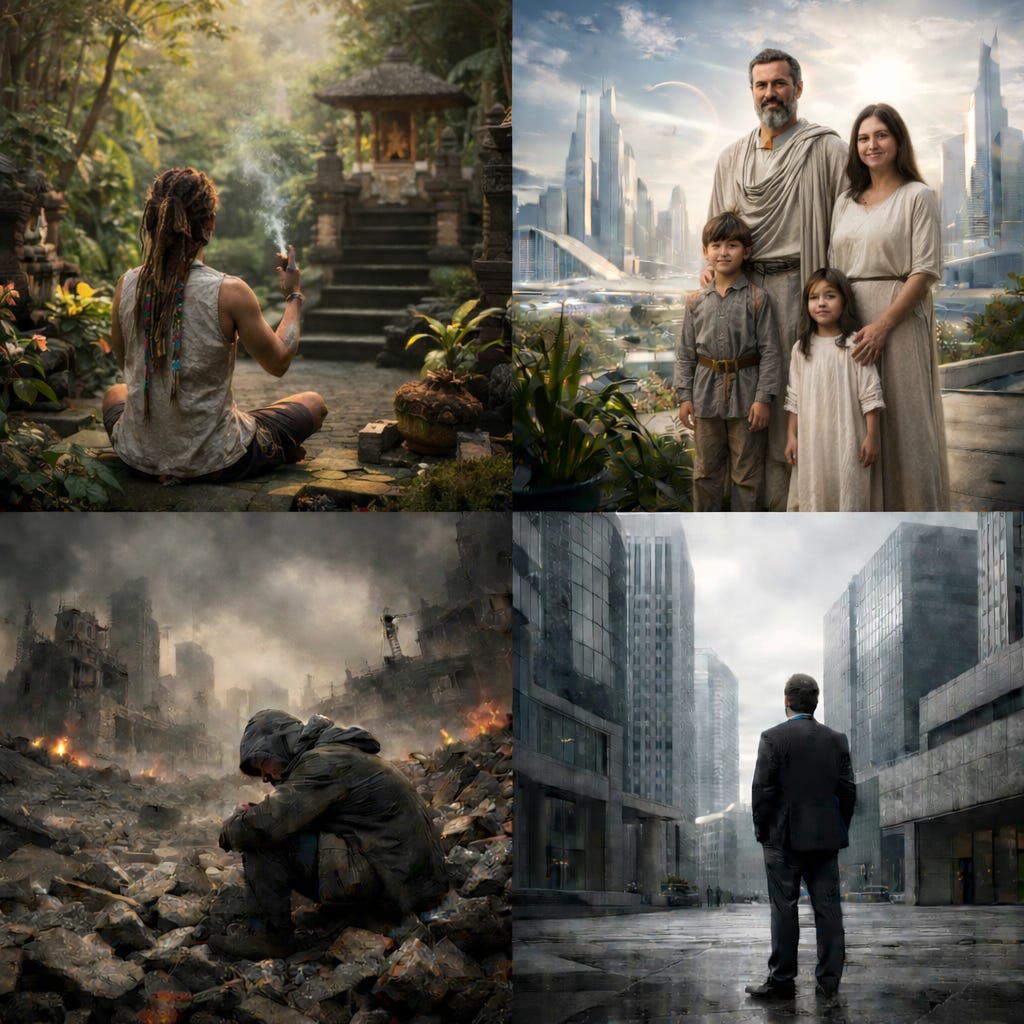
The “Agentic Sage” knows that very small-seeming aligned actions have a disproportionate impact on the whole system. They have developed the skill of navigating the world through a fine balance of intellectual analysis led by energetic perception. This is reflected in the information they consume. By far the most important skill to cultivate in the post-AI age is becoming increasingly sensitive to how a piece of information makes you feel. I have yet to consume any AI generated content that gives me an embodied charge. If you stick to information with an exciting energetic frequency that aligns with both your personal curiosity and the good of the whole, it’s likely that it will change you for the better. If you share it and discuss it, ideally in community, that evolutionary process is accelerated for everyone.
[Who is in your top right quadrant? Tell us all in the comments].
I keep thinking about Richard Rohr - contemplation AND action. An off the record conversation with him would probably yield astonishing insights.
This will sound very out of place, but healthy gamer on YouTube has memberships where he talks about psycho/spiritual stuff, giving concrete actions for evolution of our inner world. Highly useful and not just philosophy.