

[This conversation has a 7.5/10 Woo Rating]
God is the Leading Edge
-Tim Freke
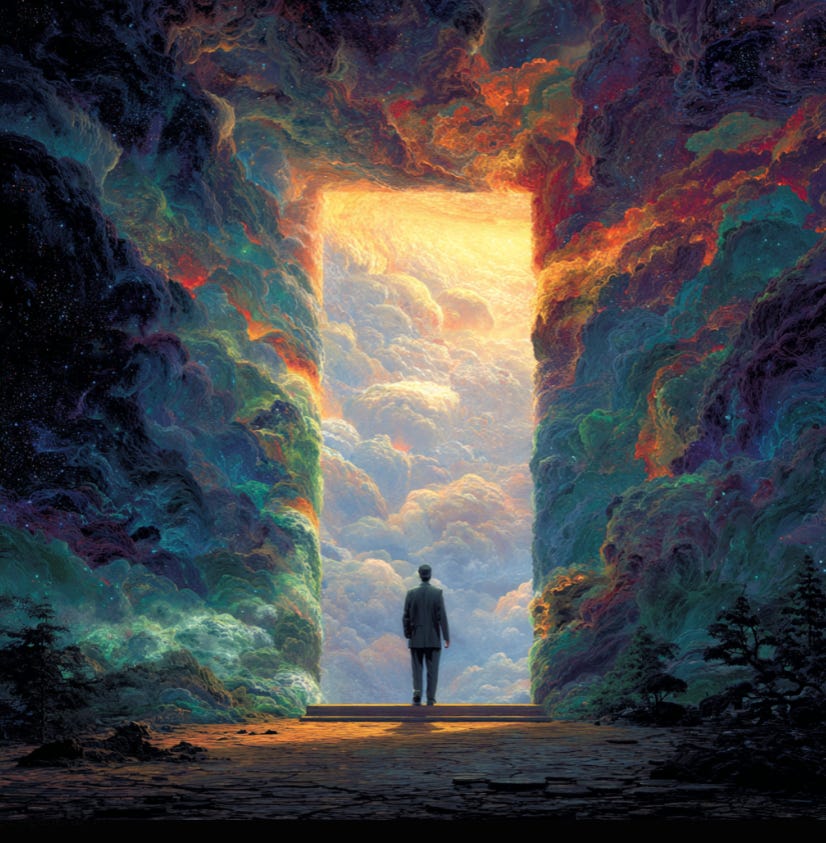
I live for the energetic charge I get when I think I’ve found someone whose thinking is right at the leading edge. Thanks to the reliable nose for novelty of Kainos’ founder Alexander Beiner, I was recently introduced to the work of Tim Freke. He’s the author of thirty-five books on hermeticism, mysticism, consciousness and spirituality. One of the first things I liked about him was his opening statement about how much his worldview has evolved over the course of those books.
It is increasingly clear to me that we are standing at the threshold of a dramatic change in our collective perception of the world. But many people are either totally oblivious or standing at the doorway facing backwards into the past. My general belief is that, if any of the existing spiritual traditions or religions were the definitive answer to today’s metacrisis, they would have solved them already. But this doesn’t stop the constant appeals to previous ideas and cultures as “the one definitive answer.” Freke jokes that even the Taoists thousands of years ago believed that their forebears millennia before them were the only people who truly “got it.” And while previous cultures and thinkers are obviously exceptionally useful, what is happening now is entirely new by definition. And therefore this moment requires an equally new worldview, ideally one that transcends and includes science.
Freke has spent the last ten years developing his new “Unividual” worldview, and he has released it as a free “podbook” online called Why Your Life Really Matters. I devoured the available chapters in a couple of days and emerged with a lot of questions. This interview is an introduction to his ideas (available on Spotify and Apple Podcasts). It’s one of my favourite conversations I’ve had, because of how many of Freke’s ideas I’d simply never even thought of before. And yet they made a lot of sense.
Freke has had the unusual courage to evolve beyond the views he himself espoused in his first thirty four books. He was previously significantly influenced by the perennial philosophy. This proposes that all spiritual traditions point to a single underlying reality, variously described as consciousness, spirit, or the divine. But he says he spent so long refining and articulating this idea across his prior books that he started to realise where he might have been wrong.
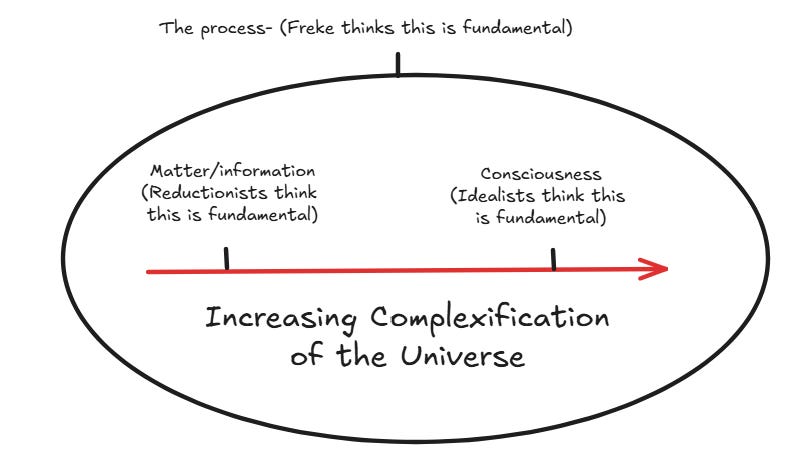
The reductionist scientific community has long argued that the foundations of the universe are categories appropriate to the lowest levels of reality, like information or matter. But as we’ve increasingly realised consciousness isn’t solely confined to matter, many people (called “idealists”) are coming to believe that “consciousness is primary,” basically the foundation of the universe before matter emerged. Freke thinks that might be making a mistake: we are applying something that emerged far later in the process, consciousness, to the beginning. Instead, he believes what’s fundamental is the process of unfolding itself. “Idealists” take the latest, most emergent property of the universe (consciousness) and say it’s the foundation of everything, reductionists take the earliest, most basic property of the universe (matter) and say it’s the foundation of everything. But Freke rejects both and argues that the process of emergence itself is the foundation. As he puts it: God is the Leading Edge (and we didn’t pay him to say that).
Freke makes the compelling point that contemporary technology can be an analogy for the evolution of a deeper reality. Our present paradigm shift is being driven by the broadening understanding that consciousness is not confined to our physical bodies. Our current technology mirrors this dynamic: in cloud computing the Internet is both in our local device and globally distributed. The dramatic realization that will follow this shift is, not only is consciousness non-local, but reality also has an emergent direction. Freke thinks A.I. has evolved as an excellent analogy to show us this underlying process that drives everything. A.I. is imitating what the cosmos does. A.I. takes all the existing information on the internet, then remixes it to create something entirely new. But whereas A.I. only produces novel combinations of digital information like words and pictures, his belief is that reality is doing this all the time with everything. The past is like our collective hard drive storage, and the unfolding present is remixing that in ways that are perpetually totally new.
God could be what started the process, something that sits outside of the process or, as Freke believes, the leading edge of the process.1 I have no idea which I believe. But for me, the value of Freke’s worldview is in helping us understand this emergent evolutionary process as it relates directly to our own lives.
The Emergence of the “Unividual”
It’s currently popular to argue about whether the individual is a creator or receiver of consciousness. Is the Internet only in our device, or in the cloud and our device? Freke thinks we should consider a third option: that we have evolved a psyche as another sensory layer from our material bodies. We are now capable of experiencing the material world with our biological senses while simultaneously experiencing an “imaginal” domain made up of images, memories and dreams. We do this literally every time we physically sit at our desk and daydream in our heads. Our psyche is the most recent, most emergent, part of us, which is what distinguishes us from plants and animals. Many animals experience psyche - that they dream is an obvious sign - but we have specialised in psyche.
Because everything is constantly emerging, there must be a totally new kind of human evolving now. Freke calls this the “Unividual.” He argues that what we describe as “spirituality” is the most emergent level of what this new Unividual psyche is capable of experiencing. As a result those experiences tend to be subtle and can even involve emergent features of consciousness our current materialist paradigm struggles to explain, like psychic phenomena. This is consistent with a perspective that spiritual or nondual experiences used to be confined to a relatively small percentage of the population, but they now seem to be increasingly widespread.2
What’s inspiring about Freke’s Unividual worldview is it situates all of us, including you, at the frontier of evolution. Consistent with complexity theory,3 we are all being drawn to the very edge of emergence (and sometimes over it).4 Something that is complex, like our body, is made up of a huge number of differentiated parts that are seamlessly integrated into a whole. An orchestra of trombones all playing the same song are integrated, but not differentiated. All the instruments playing different songs is differentiated, but not integrated. A full orchestra playing the same song are both differentiated and integrated. The closer you get to your own leading edge, the flow of doing what you love (differentiation) in service of love (integration), the closer to experiencing “God” you’ll get. Unlike more individualist spiritual traditions this defines the individual in terms of their relationship to the world.
Freke describes the emerging Unividual as capable of being “Paralogical,” which means they are able to fully embrace paradox. According to Freke, what we call God is not a separate being who made the universe. God is experienced as the collective, emergent consciousness of all individual souls in communion with each other. This is an unfolding supersystem of individuals that increasingly knows it’s integrated with everything. This is the kind of paradox the Unividual is comfortable with. There’s a real elegance to the idea that a Unividual is defined by their ability to grasp the definition of a Unividual.
Our role in the evolutionary process is therefore to get increasingly aware of how much each of us is both unique and integrated with everything else.
This means that Freke has also had the courage to evolve beyond another view he himself espoused in his first thirty four books by criticising one common perception of “nonduality.”5 At the earlier stages of my spiritual journey, I was confidently told many things that were ultimately at odds with my lived experience. For example: I was told that I actually had no free will and that my “self” was just an illusion that had to be dissolved. In contrast, Freke believes the role of the individual ego is critical. As he puts it, we didn’t spend billions of years evolving an increasingly conscious and agentic ego as a mistake. We did it to perceive our individual role in this process of unfolding increasingly accurately and truthfully.
Indeed, he says his favourite way to experience this is to simply look at another person and deeply reflect on the fact that you are communing with their psyche, their soul. We do this every time we take a Zoom call: we are clearly interacting directly with someone’s “imaginal” psyche, not just their physical body. We are suddenly unified with them, collapsing physical distance. Because Freke isn’t merely an abstract philosopher, and has been running retreats for years, he has produced a guided meditation exercise that he believes can help you experience the reality of his worldview.6
Freke’s Unividual worldview aligns in many ways with the broad cosmic perspective of The Law of One, which has been deeply influential on me. The Ra material places this evolutionary force of emergence as something that loops infinitely through eight different octaves of existence, each both more differentiated and integrated than the last. This means we can coexist with beings that are further along in this journey, indeed Ra describes themselves as a sixth density “social memory complex.” This is when a species evolves to a level where they retain their individual differentiation, but are so integrated that they have access to all of each others experiences.
I heard a rather amusing example of this from founder and spiritual influencer-type Aubrey Marcus when he described a vision he had on a six day darkness retreat.7 At one point, glowing lights in the form of small spaceships appeared above him in the pitch-black room. He watched them for two days before finally asking aloud, “is there something you want to tell me?” To his surprise, the lights mmidentified themselves as the Star Nation of the Pleiadians. They spoke in a single unified voice, saying, “We are Pleiadian.” At one point, they gave him a new spiritual name. When he replied that he didn’t like the name, the single voice suddenly fractured into millions of individual beings, all erupting in laughter. It was as if they found the idea of a human challenging this sacred gift hilariously absurd. Then, just as suddenly, the multitude of voices recombined into their unified form.
If this anecdote is somehow true, and if Ra’s broader cosmology is somehow correct, Freke’s worldview cements the critical role of our personal destiny and agency in the unfolding of the cosmos. This is also the key to this moment’s paradigm shift: that reality has an emergent direction, and when we align with it everything goes fabulously well. This is where the human Unividual is hopefully headed.
Evolution Beyond Death
The role of death was the lynchpin that shifted Freke’s worldview. Seeing both his parents through their deaths, and his extensive research into Near Death Experiences made him believe that the psyche survives death. He makes the mindblowing claim that, as we have evolved as a species, one of the things we may have achieved is an increasingly sophisticated ability to ensure our psyche survives the death of the material body.
Whether or not he’s right, my jaw literally dropped when he made the following argument. Leaning on his decades of research into different traditions, Freke believes that our spiritual experiences themselves are evolving, especially our post-death experiences. He said that the Tibetan Book of the Dead makes reference to the deceased moving towards a divine light. But there’s no mention of this phenomenon in the Ancient Egyptian accounts thousands of years before. By the time of the Greeks, the underworld was somewhat shadowy and unformed. Then different religious groups experienced it as reunion with a monotheistic Jesus or Buddha. But now contemporary “life reviews” tend to not only show us the events of our own life, but also how they impacted everyone we ever came into contact with. As we become more interconnected as individuals, our spiritual experiences are evolving in tandem. Our afterlife experience is itself becoming more “Unividual.”
If we can reframe the psyche as something that continues evolving beyond death, as Freke argues, we can have a dramatic cultural paradigm shift. This seems to be happening at this precise moment in our evolution.8
I recently finished Dan Brown’s number one New York Times Bestseller The Secret of Secrets. After eight years of research into the science of consciousness and Near Death Experiences, he says he no longer fears death. His book also cites research that finds our exposure to constant death anxiety and fear makes us fundamentally selfish. Imagine what happens when that fear diminishes?
“Just think about that. The one universal fear that drives so much of humankind’s destructive behavior… would evaporate. If we can hold on long enough to arrive at that paradigm shift without blowing ourselves up or destroying our planet, then our species may well turn a philosophical corner that ushers in an unimaginably peaceful future…
… Death is not the end. There’s more work to do, but science continues to discover evidence that there is indeed something beyond all this. That message is one we should be shouting from the mountaintops, Robert! It’s the secret of all secrets. Just imagine the impact it will have on the future of the human race.”
-Dan Brown, The Secret of Secrets.
Our conversation is available on Spotify and Apple Podcasts. Aside from the podbook Why Your Life Really Matters, you can learn more about Tim’s work on his website. He also has a community of practice called the International Community of Unividuals (clever acronym: ICU). You can join it here. I also personally believe in financially supporting the depressingly small number of people working on inspirational future visions like Tim’s, and you can donate to him here.
Freke believes that, as our psyches have evolved, so has the accuracy of our understanding of this God-as-process. In our shamanic past, the gods were animals. By the time of the Ancient Egyptians they were human-animal hybrids. By the Ancient Greeks and Romans, they were a variety of human gods. By the time of the Old Testament, God had become an (occasionally angry) father figure. Christianity then represented a major paradigm shift towards a loving God. Right now he thinks our understanding of God is moving towards a recognition that God is the process of becoming itself.
Trish Blain - Alive Edges wrote one of the best articles of the year for Alexander Beiner Kainos called “Life is Woo.”
Check out my short interview with living legend Ervin Laszlo for more.
There’s an obscure, almost psychoactive book called Living at the Edge of Chaos by Helene Shulman that I was reading at the moment of my awakening experience in 2017. Going over the edge of chaos can be a reordering phase, perhaps crossing the threshold in a hero’s journey context (I suspect this is what happened to Robert Pirsig in Zen and the Art of Motorcycle Maintenance too). “It is thought they maintain themselves at a subcritical state that is at the edge of order and stability, but sometimes go over into the edge of chaos to go through a creative reordering phase. It is also possible to go too far into an ordered, frozen region into a critical state where no learning can occur. In the critical state, a small perturbation could potentially cause a big transformation because the system has grown inflexible. Ecosystems that have achieved some control over their interactions and evolvability would best be able to “ride” changes in the environment and adapt to them. They can evolve their can evolvability.”- Shulman
This is admittedly pretty niche content, but I was really entertained by Tim’s conversations with Rupert Spira on nonduality and Tom Campbell on consciousness being primary. At times, Freke’s worldview does indeed see a little less abstract and a lot more commonsense.
From the bonkers podcast Activating Your Spiritual Potential Through Angels, Crystals, Colors and Metals | Dr. Robert Gilbert
For more detail check out my article The Sword the Slays the Dragon.
I’m not quite sure what to think of Freke’s view on the evolution of spirituality. But I do think that the choice between believing in gawd and believing that Charles Darwin was the most impactful scientist in the long history of Homo Sapiens is an easier choice.
Yes, totally with you. His conversation with Ali rocked my socks, great questions too, thank you🙏 And for this gorgeous substack synopsis; I'm really looking forward to hearing your conversation with Tim!