


If the purpose of our existence is the evolution of our consciousness, then accurate maps of human development are essential. They show us where we currently are, and where we might be headed next.
In a generally pessimistic world, the implications of these models can be incredibly optimistic.
One of my spiritual mentors, Bodhi, has identified Tara Springett as his favorite teacher for anyone seeking a path to higher consciousness. He also describes her book Stairway to Heaven as life-changing. I recently interviewed Tara, along with Leading Edge’s Chief Mystical Officer Jeff Williams. Our conversation is available on Spotify and Apple Podcasts.
The stages in Tara’s book are somewhat analogous to other developmental maps like Spiral Dynamics or Integral Theory. But, as she told us in our conversation, she feels the advantage of her model is that it more comprehensively examines both the lower stages in the first half of the staircase, and the more mystical ones in the second half.

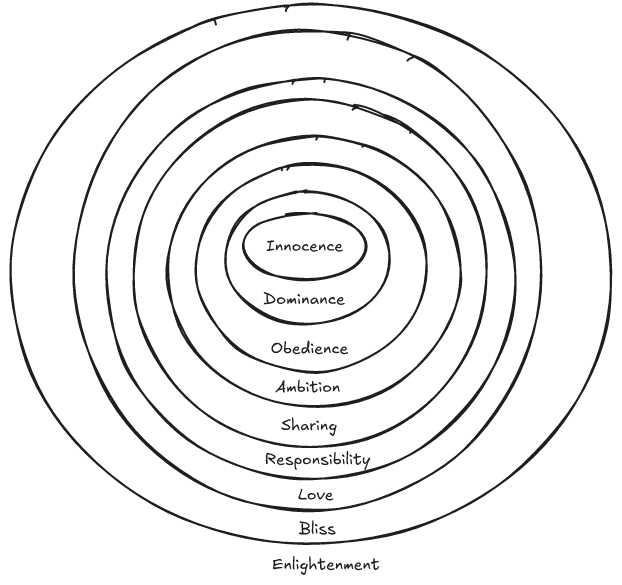
As you may recall, I prefer to view stages models as a holarchy not hierarchy: an expanding onion not a staircase.1 We transcend and include each of the stages and a bad day can push any of us right back down. Tara describes each stage in detail in our conversation (and there’s a longer description at this footnote2) but this is what someone at each stage might say:
Step 0 – Innocence: ‘I belong to my group’.
Step 1 – Dominance: ‘I want it and I want it now!’
Step 2 – Obedience: ‘I do what is expected of me.’
Step 3 – Ambition: ‘I want to achieve more than anyone else.’
Step 4 – Sharing: ‘I am close to others and to nature.’
Step 5 – Responsibility: ‘I realise my dreams for the best of humankind.’
Step 6 – Love: ‘I send love to heal the world.’
Step 7 – Bliss: ‘My true nature is spiritual bliss.’
Step 8 – Enlightenment: ‘I am love’.
Tara’s stairway illustrates the evolution of our relationship to the essential forces of love, power and wisdom. Modern spirituality can have a rather tortured relationship with power. But Tara has a pretty straightforward three part framing:
Love: The deep wish for oneself and others to be healthy and happy.
Power: The ability to change oneself and one’s environment.
Wisdom: Using love and power in perfect balance.
Each step on the stairway oscillates between love and power, but the swings get less dramatic as you evolve upwards. At the earliest innocence stage we live in blissful ignorance, but with minimal personal agency. We then swing to an aggressive dominance stage. By the top of the staircase, the state of enlightenment is defined by a fine balance of love and power, with a slight bias towards love. As you can see, love is also the key to evolution up the staircase.
Bodhi has maintained that Tara’s “sending love” practice is the most powerful (and easiest) spiritual practice he’s found.3 And for all its simplicity, our Leading Edge community has repeatedly confirmed its effectiveness. Tara goes into more detail in our conversation, but essentially it involves imagining somebody you love (or, even more powerfully, someone you dislike). You then visualize them surrounded by loving light and imagine it suffusing their heart, head and being. You can then say “I wish you to be happy and healed.”
Tara’s Stairway is equally applicable to society as it is to individuals, and it’s a source of profound optimism for her. This is because she believes you can currently witness our culture moving through ambition and into sharing, with very early signs of the responsibility stage.4 The limitations of each level of consciousness can lead to progression onto the next stage.
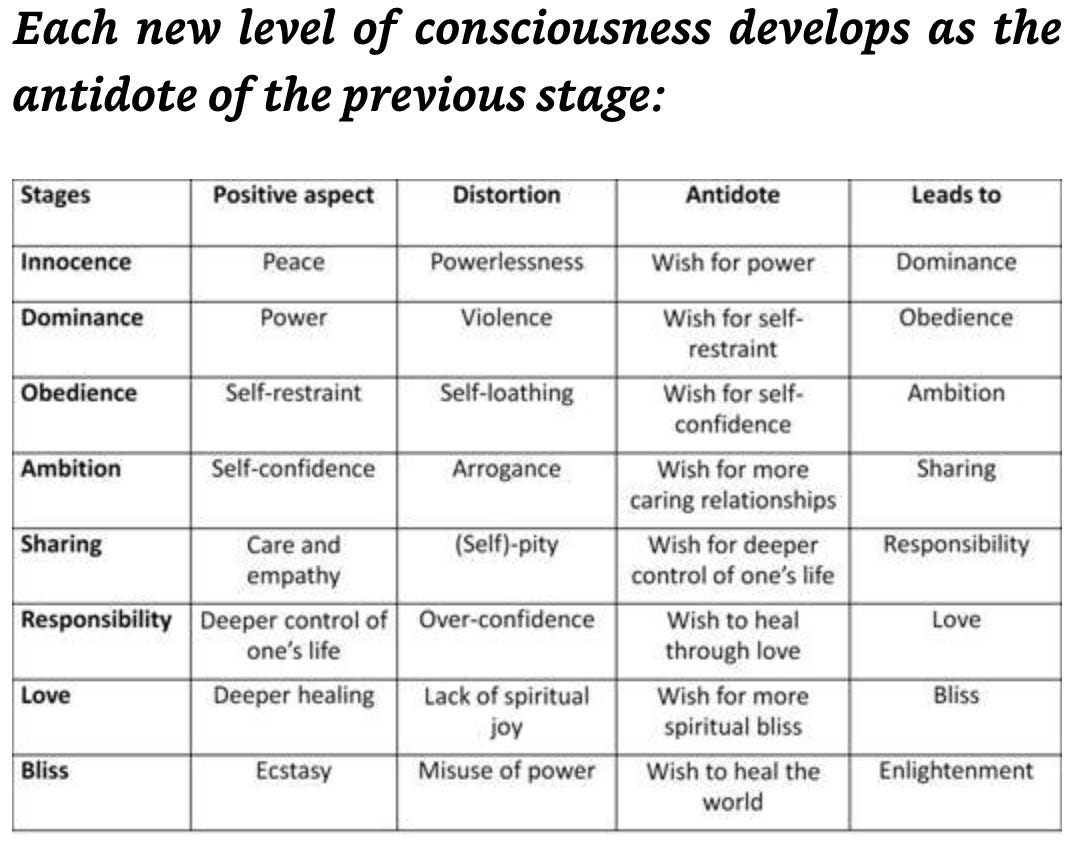
One pain point of the ambition stage is a sense of meaninglessness, which leads to the desire for the deeper connection and relationships found at the sharing stage. One pain point of the subsequent sharing stage is an obsession with trauma that can lead to a sense of victimhood. Another is an over-emphasis on equality that denies individual exceptionalism or achievement. These are all obviously extremely prevalent features of today’s society. The sharing stage then leads to the responsibility stage where you increasingly take ownership of your own spiritual path. Once again: its a swing from a focus on power at the ambition stage, then love at the sharing stage and back to power at the responsibility stage. But with an increasing connection and sophistication.
For the last few months I’ve been captivated by an image from my interview with Peter Merry, an expert on Spiral Dynamics.5 He says that Don Beck, one of the theory’s founders, likened putting pressure on a social system to squeezing a balloon in the middle. You get a bulge of people who regress back downwards towards what Tara would call the dominance and obedience stages. But you also get a bulge rising upwards towards a breakthrough in consciousness. This would be her love, bliss and enlightenment stages.
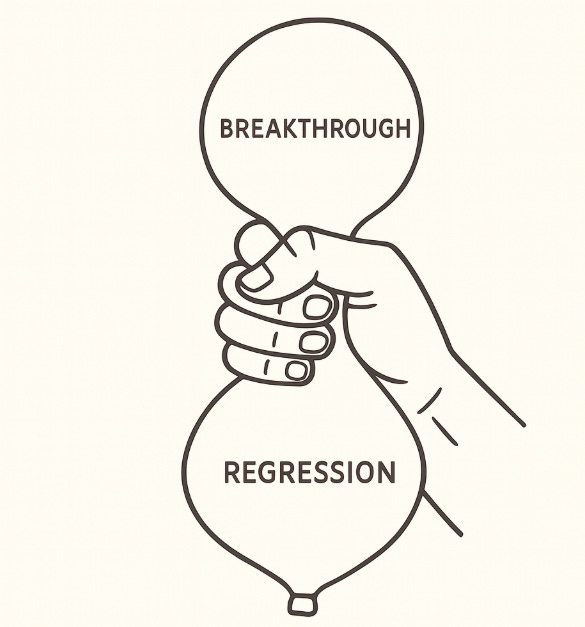
In today’s world, the downwards regression is much more obvious and therefore gets far more public attention. But I can promise you the upwards breakthroughs are happening. They are just much more private, and much more subtle. I am currently witnessing elite professionals spontaneously develop intuitive gifts. Portfolio managers who can now heal energetically. Neuroscientists becoming precognitive. Journalists learning telepathy. I wouldn’t believe it myself if I didn’t know these people personally and count them as friends.6
As you hit Tara’s bliss stage these powers increasingly come online. Indeed: she notes that paranormal experiences are frequently a feature of Kundalini awakenings, including my own, where I had an extremely unexpected period of precognition and empathic sensitivity. As she notes, it’s really only the ambition stage that denies the existence of paranormal experiences. But sadly this is still where much of the Western world still resides. The stigma and skepticism around these intuitive gifts is another reason why this evolutionary emergence is largely happening in private.
In our conversation, Tara also noted that the greater willingness to discuss Near Death Experiences (NDEs) shows our “ambition-centric” culture may finally be coming to accept non-physical phenomena of consciousness. She relates that, only twenty years ago in the US, confessing to an NDE could land you in a psychiatric ward. And now many of these non-ordinary experiences are part of the curriculum that they teach to hospice nurses.7 Concidentally, or not, it’s become increasingly apparent to me that the rising mainstream openness to consciousness surviving death could be a central catalyst for a paradigm shift. Indeed, it may accelerate our transition to the second half of Tara’s staircase. 8
As with any of these models, you don’t need to believe they apply to our culture in order to use them effectively as an individual. But they reinforce the comforting reality that your personal dissatisfaction with material success and a draw towards something greater is a natural part of our evolution. However much those stuck at the ambition stage may still desperately try to deny it. They cannot be as optimistic about the trajectory of society because they cannot grasp the realities of the more integrated stages beyond them. One of the most interesting phenomena of these models is that “the lower can’t see the higher.”9 Instead they tend to focus on doomy analysis and reductionist dissection. Meanwhile those standing at the leading edge are increasingly finding communities, connections and content that accelerates their evolution towards loving wisdom and a better world.
[Our conversation is available on Spotify and Apple Podcasts. We also discussed other hot topics like spiritual evolution in relationships and the role of substances in spirituality. You can learn more about Tara at her website. She currently offers sessions for Kundalini Support (I desperately wish I’d had access to something like this at the time of my own awakening!)]
From: The Map of Our Future “I’ve now decided that Her blue book changed my life and as I’ve revisited her many other books I’ve come to conclude she has simultaneously provided both 1) the most comprehensive teachings and 2) the most practical applications of anyone I’ve encountered. Yes, there are other mystics with far greater abilities or more captivating stories, but no one makes it as consistently accessible and practical as Tara.”
Step 0 – Innocence: Passivity; little motivation; lack of awareness; sense of relative harmony; pleasure and trust; the individual says, ‘I belong to my group’.
Step 1 – Dominance: Wish to dominate others if necessary in a ruthless way; anger; greed; the individual says, ‘I want it and I want it now!’
Step 2 – Obedience: Submission and adherence to moral and social rules for the greater good of all; hierarchical structures in groups of people; self-denial and judging of others; the individual says, ‘I do what is expected of me.’
Step 3 – Ambition: Rational world-view; creating a successful self-image; materialism; competitiveness; the individual says, ‘I want to achieve more than anyone else.’
Step 4 – Sharing: Search for compassionate relationships; exploration of one’s emotions; egalitarianism; living in harmony with nature; the individual says, ‘I am close to others and to nature.’
Step 5 – Responsibility: Taking full responsibility for every single problem in one’s life; keen interest in personal development and following one’s vocation, the individual says, ‘I realise my dreams for the best of humankind.’
Step 6 – Love: Making altruistic love and spiritual development the most important aims in life; the individual says, ‘I send love to heal the world.’
Step 7 – Bliss: Realisation that one’s true nature is blissful loving space; development of supernatural powers; withdrawal into spiritual retreats; the individual says, ‘My true nature is spiritual bliss.’
Step 8 – Enlightenment: Infinite love, bliss and wisdom; seeing oneself as divine and the world as a paradise; the individual says, ‘I am love’.
Bodhi’s article is: The Most Powerful (and easiest) Spiritual Practice I’ve Found
This was recently echoed in Oli Weatherall ’s article A silver lining to the past decade?
Our conversation Rainbow Onions and Turquoise Gardeners finally helped me understand why these maps are so important.
Tara also noted demand for her services is increasing in such a way to lend support to the idea that spiritual awakening is becoming significantly more widespread.
See What Deathbed Visions Teach Us About The Living in the NYT. It was also interesting to see the WSJ (!) tackle NDEs and Terminal Lucidity last week in Can Science Reckon With the Human Soul?
Appropriately, the first episode of Series 2 of The Telepathy Tapes is about NDEs. And it’s extremely compelling stuff.
Read more here. For what it’s worth, the bliss and enlightenment stages seem unattainable and unrealistic to me, at least in this lifetime.
Maps are funny things. Everyone thinks they want one until they realize it leads straight through their own basement. I like her staircase though. Most of us just keep redecorating the same step and calling it transcendence.
I was such a pleasure to see and hear you two having this conversation with Tara! 💛