

I was recently listening to a podcast by controversial founder and spiritual-influencer-type Aubrey Marcus. He described a visionary experience during a darkness retreat five years ago. When I heard him tell the story, it gave my entire body chills.
At the time, Marcus’ father was still alive, but lost in monstrous psychosis. They hadn’t had meaningful contact for years. Sitting in prolonged darkness can trigger the release of the powerful endogenous hallucinogen DMT. A few days into the retreat, Marcus had a vision. His father appeared sitting calmly in the corner of the room, reading a book.
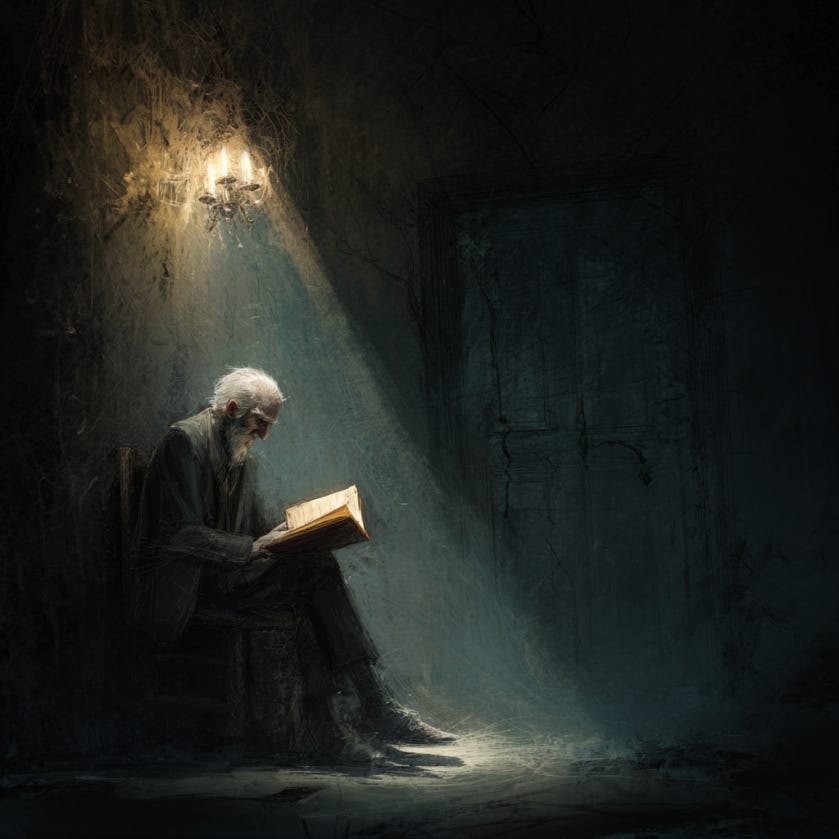
He asked, “Dad, what are you reading?”
His father looked up and replied, “The Book of Lies.”
“Why are you reading that book?” he asked.
His father replied, “Because I never thought I was enough. I never thought I was worthy of love. So I had to read the Book of Lies to tell me that I was worthy… so I could love myself.”
Then his father closed the book and tossed it over his shoulder, and said, “Son, know that you are always worthy of love. No matter what you do, no matter what happens- you are always worthy. And you’ll never have to read the Book of Lies.”
Marcus replied, “I love you, Dad.”
Fighting the Prince of Lies
On December 31st 2017, I was running through Central Park listening to a Jordan Peterson podcast about Hell and the Garden of Eden. In a Q&A session after the main lecture, Peterson talked about a vision he once had in which God throws him into a Roman amphitheater to fight the Devil. After Peterson prevailed, he asked God why he did it. God replied, "Because I knew you could win”.
This battle was still on my mind when I got home. As I toweled off after a freezing cold shower, I was surprised to hear a voice come directly out of my body. It said, "I’m ready for the hero's journey, I want to fight the Devil, I am ready for a son."
I then wrapped myself in my towel, sat on my sofa, and scrolled my phone, trying to understand these strange thoughts. My spiritual awakening experience two months prior had come with a feeling of pressure between my eyes. I was curious about the topic. So I Googled "is the third eye...", and it auto-completed to "evil." I clicked the first link and arrived at a blog in which a woman claimed that she had risked damnation by dabbling with the occult as a teenager, and only by repenting and converting to Christianity had she saved her immortal soul.
I suddenly became gripped by the cast-iron conviction that I too was eternally damned. The entirely sleepless night that followed was filled with horrific waking visions and literally paralyzing fear. It was the worst night of my life. Hostile thoughts started looping incessantly in my head. It wasn’t some kind of “external” demonic growl. It was the same internal voice I usually hear in my head, as I tend to think in words, not images. Unlike Aubrey Marcus’ father, these weren’t grandiose delusions, they were the opposite. The thoughts told me that I was worthless, that I was damned, that I was disabled, that I was unloved, that I was alone. They didn’t stop for more than two years.
Every day afterwards became a death march. My dominant preoccupation was my professional future. Whether I could live a meaningful life without betraying my family. If I would run out of money, and what I would be worth as a husband and father if I did. If I even had any potential at all given I was now officially “mentally ill.”
The thoughts were completely overwhelming. I couldn’t really speak to other people or even think about anything else, including my own family’s urgent emotional needs. It was rumination without relief. When you’re at war with your own mind there’s nowhere you can go and nothing you can do to make it stop. Time itself becomes your enemy. I started a spreadsheet to estimate when I might die of old age, and hoped it would be before the shame of running out of money. The only half-decent moment of my day was the two seconds just after waking up, before the thoughts came back online. As I was sure I was eternally damned, I took to constantly praying the rosary (even as a non-Catholic) just to try and create a counter to the chatter. It didn’t work very well.
About a year into this insanity and depression, my psychiatrist recommended Cognitive Behavioral Therapy (CBT). This is apparently aimed at changing negative or unhelpful thinking patterns. Perhaps I was “doing it wrong”, but this method always ended with me pitting myself directly against my own hostile monologue. I was advised to set up a tally counting app on my phone. I opened it each time I had a negative thought. Often as much as eighty times a day I tallied a thought loop: “you are worthless” or “you will run out of money.” The thoughts came so often they rapidly wore down bloody grooves in my mind; each time I had one it was like running sandpaper over a deep graze.
But, despite whatever the various gurus had claimed, becoming more aware of my thoughts did nothing to stop them, or even slow them down. As the psychiatrist Phil Stutz puts it, “the worst thing is to argue with thoughts.” My inability to rise above the suffering and meditate it away just added to my suffocating sense of failure. Bone-deep shame was the only emotion that I could feel. Another one of the entirely ineffective pieces of advice I received during this living hell was to stand in front of a mirror and repeat “I love myself.” It also didn’t work.
I wish I could say I clawed my way up the walls of that abyss with bloody fingernails using pure willpower. But “fighting the devil” didn’t work. Instead, I completely gave up trying to think or struggle my way out, and surrendered to intravenous ketamine therapy in early 2020. In my eighth and final session, I had a hellish vision. When I emerged I cried for four hours. Over the prior two years it was like there was a pane of glass between me and the world. Somebody would say something funny, I would register it as funny, but only rationally, not emotionally. Then, like an actor playing the role of the person I used to be, I would laugh mechanically. Within a week of that hellish ketamine trip, the glass dissolved and I could feel the world again. But it still took me more than a year to think clearly and speak with confidence again.
My only real achievement of note throughout those years was refusing to kill myself. When you’re going through hell, sometimes the only thing you can do is keep going.
Writing the Book of Evidence
Looking back, the most rational explanation of what happened to me was that the physics of my environment, the chemistry of my brain and the biology of my genetics, conspired to somehow break my mind. It was a shameful period of disability and mental illness that needed to be “managed.” And certainly never talked about, or written about, in public again.
The next most rational interpretation of what happened to me was that I deliberately embarked on the hero’s journey of shifting from left hemisphere dominant to right.1 The left hemisphere is hyper verbal, competitive with the right and it lies. The right hemisphere is energetic, somatic, largely non-verbal, collaborative and totally truthful. Perhaps my unconscious desire to resolve my trauma in order to open my heart to my child pitted one side of my psyche against the other.
The least rational interpretation is that I somehow literally went to war against the Devil, the “Prince of Lies.” How would our full potential ever manifest without an equivalent challenge from The Adversary?2 Out of that conflict came the person I didn’t know I wanted to be: someone who has embodied the agony of the lies of worthlessness.
At the end of the day, the cause matters surprisingly little to me now. What matters is that the thoughts in my head were lying.
I have come to believe that the “spiritual” path isn’t just to be found passively on a meditation cushion (although that helps!). It’s found in the active pursuit of doing what you love in service of love. At least eighty percent of the people I now speak to are now in search of this path, and their primary obstacle is money. Which means a (surprisingly neglected) obstacle to spiritual growth is our relationship to money. This is because money is our closest energetic proxy for self-worth.3
A deceptively simple idea is that the value of exploring mysticism is that it sets up gradual cognitive dissonance with the prevailing materialist worldview.4 Most people I know believe that our existence is a random accident resulting from a blind process of competitive trial-and-error. We are nothing more than a collection of atoms that’s going to be around for the blink of an eye then be dead forever. We’re matter that doesn’t matter. We are, ultimately, worthless.
In contrast, a more mystical worldview suggests that we all play a meaningful role in the entire cosmos. Our soul may survive death and our purpose in this lifetime is the evolution of our consciousness in service of love. And means that love may be a more powerful force than money. It’s just that most people I know don’t believe that. Certainly not enough to make consequential life decisions on that basis. And yet… once they start to really pay attention, every single synchronicity, every little benign wink, undermines the lies of separation and worthlessness.
When I felt I was damned, I thought I needed to force myself to believe propositional Christian facts in order to be “saved” from eternal suffering. Now I believe faith is about making the first move, but then looking for evidence. Faith is suspecting that your path is to bring forth exactly the same unique value the lying thoughts in your head deny.
Fears of scarcity and failure constrict precisely the same subtle senses that will guide you out. Those fears can blind you to evidence that’s already sitting right in front of you. I recall eating lunch with my family in London just days after my descent into madness. I told my visibly-concerned sister that I truly believed our late father would have agreed that self-sacrificial hospice work was a nobler path than anything I could do with my “meaningless” finance skills. Less than five minutes later I obliterated the entire family in a game where you link ideas and people together. This is my rather boring superpower and passion, honed on Wall Street. Then again, multiple times during the darkest days, I wrote passionately about subjects I cared about, but the thoughts told me “You’ll never get paid for writing online.” They were lying.
Eventually I just let my outer experience provide the evidence, not the inner thoughts. I started writing about consciousness and life transitions, but for my old finance audience. Almost immediately I was offered my dream job out of nowhere, one that maximised all my skills and passions; my inherent value. When I let go of preconceived outcomes and just did what I couldn’t-not-do, the doors opened where before there were only walls.
I am still not in a place where I can entirely believe in my “intrinsic worth.” I am horrible at accepting compliments and mostly deflect them with self-deprecating British humor. The closer a compliment gets to my core, the less I’m willing to believe it. I am quite happy to be told I’m wearing a nice shirt, but if you tell me I’m a truly good person it bounces off me like rain off a windshield.
What has happened instead is that the path itself shows me my value. I don’t mean this to sound grandiose, but I sometimes get really positive messages. And then, far less often, I will get an email saying my work stopped someone from killing themselves, or helped them get over the death of their toddler. And honestly having received just one of those emails means I could stop now and be content with my life’s work.
I still occasionally wonder if I really am damned. It’s hard to communicate the depth of conviction I once had behind that delusion. I still wonder if it’s possible to forfeit your immortal soul. Are certain mistakes so bad they’re permanently irreversible? I also wonder if I did something pretty horrendous in a past life I’m now paying for.
But, if I am indeed damned, I hope the judge will at least allow me to present some of those emails in my defense. And some mornings when I look into my sleeping son’s face, I see God smiling right back at me. And I think he wants me to be happy now.
Perhaps he knew I could win.
Here’s a longform explanation of this idea. My experience mapped pretty closely. Stasis at work, a call to adventure through exciting ideas, refusal of that call for a safe job, a health crisis, encounter with the anomaly (awakening experience), willingly crossing the threshold that night, then the immediate descent into the abyss. Finally the encounter with the shadow self, a death and rebirth with the ketamine and a return with the boon of a more integrated personality.
I tend to believe viral mass media moments can sometimes reflect the collective unconscious. As I’m a mediocre parent, I’ve watched Kpop Demon Hunters roughly four times. It’s now the most watched Netflix film in history. The central antagonist is a demon called Gwi-Ma who feeds on souls by putting voices of worthlessness into our heads.
My interview with money coach Nadja Taranczewski has really helped me understand this concept more fully.
Check out this excellent passage from Daniel Thorson on The Architecture of Safety
“Consider the felt difference between these worldviews:
Materialist Cosmology: We live in a meaningless universe of competing matter, where survival depends on our ability to control and extract resources. Consciousness is an accident of chemistry, death is extinction, and ultimately nothing we do matters.
Sacred Cosmology: We exist within an intelligent, loving cosmos where we are fundamentally welcome. Our lives have inherent meaning and value, we are held by something larger than ourselves, and even death is a transition within a larger wholeness.
These worldviews generate entirely different nervous system responses. The materialist worldview creates existential anxiety—a bone-deep sense that existence itself is fundamentally unsafe. The sacred cosmology leads to a felt sense that we belong here, that reality can be trusted.
The relationship between these two dimensions of safety reveals something crucial: when our nervous system carries traumatic patterns, entertaining a sacred cosmology can feel threatening because it highlights the gap between our lived experience and the view of cosmic welcome. Yet this same dynamic makes sacred cosmology a powerful healing tool. Within a materialist framework, our defensiveness makes perfect sense—of course we should be skeptical and guarded. But when we consciously adopt a sacred worldview, our defensiveness creates friction with the reality we've embraced, and this tension naturally draws us into intimate contact with whatever wounded material lives in that gap.”
Really appreciated this one mate. Made me think of the Nietzsche line: “498. Condition for heroism. : If a man wants to become a hero the serpent must first have become a dragon: otherwise he will lack his proper enemy”
Hi Tom -- I love reading your writing. This time, I listened to you reading the piece aloud while I lay in a hammock; from now on, I'll expect you to trek out to Westchester to read to me! Thanks for sharing these valuable thoughts. When you mentioned how difficult it is to receive a compliment or to believe that you're truly a good person, the facetious Englishman in me wanted to joke, "Eh, you're a PRETTY good person!" Maybe that's about as much praise as we can handle! On a related note, I listened to an old lecture today by Michael Berg about this week's Torah portion; he was saying that the entire purpose of this month of Elul that leads up to Rosh Hashanah is to discover the greatness of your own soul. The Kabbalists say that, when we die, there can be this terrible moment (a sort of hell, I guess) when we might finally see the gap between who we were in this life we lived and what we were actually meant to be. So, it's better to discover it now and try to live up to it. Likewise, there's a beautiful teaching from the Kotzke Rebbe, I think, where he said that "the greatest sin of all is to forget that you are a Prince of God." I love that. Sending you warmest wishes -- William