


I’ve spent the last ten years studying life transitions and personal transformation.
Greater freedom over my calendar since I founded The Leading Edge has meant I am now meeting at least fifteen new people every week. At this point I’ve probably had ~2,600 conversations on the topics of life transitions and personal flourishing. As a result I feel I now have enough anecdata to make a few useful generalizations. They will doubtless offend as many people as they intrigue.
The 18-36 Pattern. I was once told that we spend from birth to eighteen years old essentially forming a personality. We spend the next eighteen years building our executive function. From thirty six we put those skills in service of something meaningful. It has been noteworthy quite how many people I’ve met with have had turning points or existential crises around thirty six years old (including me1)….
…The Simplicity beyond Complexity. More specifically, most people I speak to started their life in some sort of traditonal dogmatic religion. They then became dissaffected, mostly turning into “college atheists.” But at a turning point or crisis they understood the deeper meaning of spirituality. For the vast majority of people I have spoken to this happened during COVID. So, for some of those people who turned thirty six during COVID, it was like an existential nuke.

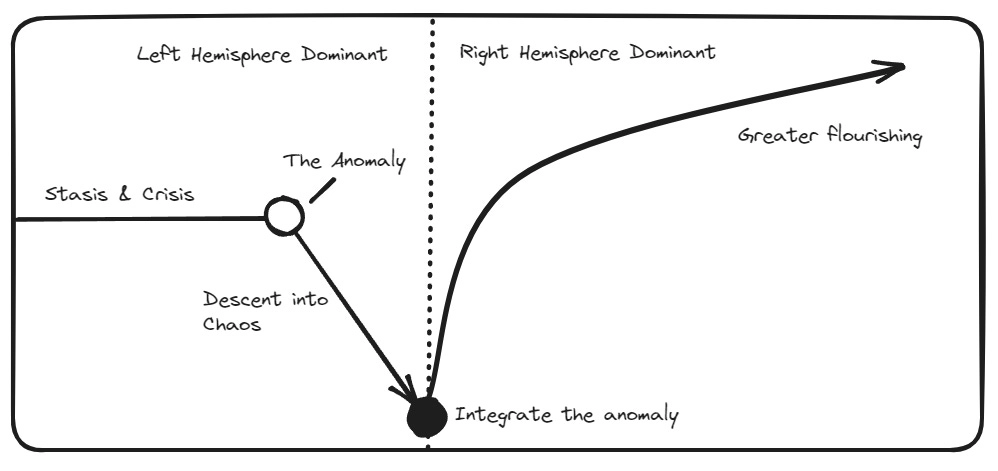
Male vs Female Transitions. It’s only ever anecdotal, but I have consistently observed pronounced gender differences in life transitions. The male midlife crisis is typically a result of either having climbed the wrong mountain, or reached the top of one. The mode of left-hemispheric cognition that has helped them achieve that success is then inappropriate for the right-hemispheric intuition they need to find their meaningful niche. In contrast, many women reach midlife and feel culturally pressured to be mothers, wives and executives with equal aptitude, despite that being virtually impossible in a 24 hour day. As a result they fear they need to let someone down or shed a critical part of their identity in order to fully individuate. Hilariously, once they’ve decided on their path, I’ve found that women consistently execute on their life transitions embarrassingly faster than men.
Unhealthy Obsession with Health. The first signs of the male transition process are often accompanied by an obsession with health optimization. This is the Huberman/Attia/Bryan Johnson biohacking genre that can mask an unhealthy fear of mortality, as opposed to a healthy desire to reduce morbidity. You can usually tell how bad it is based on how many supplements people are on.
Take. Every. Meeting. People who limit their interactions to those they deem “obviously important” reveal that they don’t understand how complex systems work. The meeting with a struggling high-schooler may do more for both of you than the S&P 500 CEO. Moreover, rich and powerful people can tend to be both isolated and extractive. A fantastic barometer of your own interactions with powerful people (via Brian Whetten2) is to notice if you are trying to prove worth or provide value to someone. The latter is always a better way to enter a fresh conversation. Not needing anything from an interaction, and therefore dropping any persona, is usually a huge relief and immediately disarming for the other person.
The Mystery of Money. Most “spiritual” communities reject money, overt networking communities embrace it, but very few honestly examine it. This is weird. Money tends to be one of the biggest barriers on our path to a life we truly love, so our money triggers are critical indicators of precisely where we need to integrate our consciousness. A simple and effective way into this examination came via money coach Nadja Taranczsewski.3 She asks us to finish the sentence: “Money is….” Try it yourself now. She hears three broad kinds of answers: negative, positive and mixed. People with negative projections would say something like “money is dirty,” and they rarely have enough. Somebody with positive projections would say “money is freedom, self confidence, luxury or power” and they tend to be wealthier. The problem is, money is then at the root of most of the important positive things in their life. These projections often have deeply personal causes and the real neglected alpha lies in examining them.
The Illusion of Loneliness. Virtually everyone I speak to thinks they are the only person struggling with the balance of pursuing meaning and paying the mortgage. They also tend to think that they are the only person they know that’s interested in consciousness and mysticism. This is despite the fact that this describes almost everyone I speak to currently. This loneliness is usually severely exacerbated by the fact that only one spouse is interested in these topics. Life transitions typically come with a deep sense of shame, despite the fact that eventual dissatisfaction with material achievement is a clearly defined stage of human development. Life transitions also often take time, as much as two to three years, when the family and financial demands often have the flexibility for a few at most a few months.
“A Closed Mind is Forced to Feed on Itself.” I’ve found that, the more dogmatic someone is, the more stuck they tend to be. This applies even more so to any worldview that enshrines the human intellect. This is because it precludes the possibility of a guiding intelligence, or even intuition. Especially dangerous worldviews seem to be: rationalism, scientific materialism, effective altruism, utilitarianism and determinism. There is also a strong correlation between how much someone talks, and how poorly they listen, and how stuck they are. I describe it as filibustering your own soul. In direct contrast, I have found that flourishing is very tightly coupled to the amount of intelligence you attribute to the world around you. This can mean other people, the stock market or reality itself. People who are willing to leave their path open to exciting side-quests and synchronicities always seem to be the most alive. The most obvious indicator is the light in someone’s eyes.
Different character, same story. The specific details of everyone’s transition story are obviously utterly unique. But the underlying arc tends to mirror the hero’s journey; which isn’t surprising as it’s a precise description of how successful transitions work.4 It starts with stagnation and the nagging sense that there’s more to life. Then there’s interest in other topics, often to do with self-development (the call to adventure). Most people regard that path as impractical, especially in light of their financial commitments to their family (refusal of the call). This is commonly followed by a crisis, such as panic attacks, a health scare or even a near-death experience like a heart attack. The person then willingly embarks on a new journey (crossing the threshold). This requires dissection of old identities and coping mechanisms (descent into the abyss and the encounter with the shadow self). Hopefully they eventually emerge with “the boon.” In today’s world this is a more meaningful life path and the story they tell others on how to pursue it. Once you understand this universal pattern you can interpret where you or someone else is likely going next. You can also hopefully avoid the refusal and crisis stages by taking your right-hemispheric impulses more seriously.
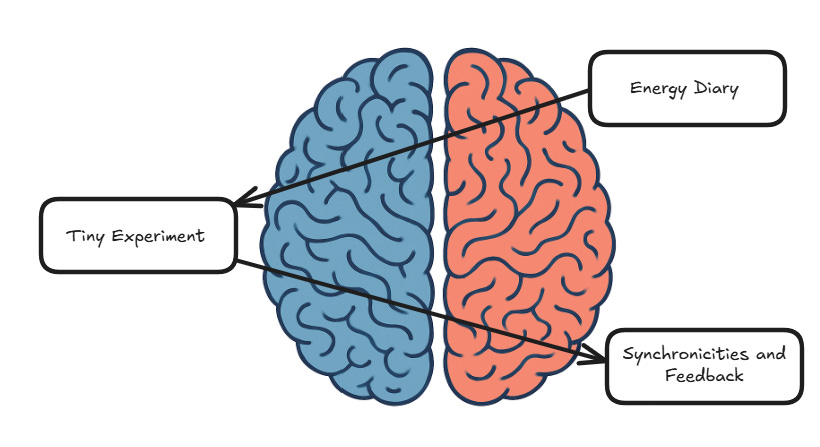
Power Tool: The Smartest Strategy Meets the Most Powerful Compass. The most effective framework I’ve seen in executing on a life transition is Dr. Anne-Laure Le Cunff’s Tiny Experiments. The best way to design Tiny Experiments combines them with the most powerful tool: the energy diary. If you pay close attention to what builds and drains your energy and then use that to design an experiment, you have a very robust way to tap into emergence for your next steps. This could be cooking a dinner party, teaching, coaching, writing or creating. Ideally it has to be fun, open, and in service of others in some way. I have found that the universe especially rewards paths that evolve your consciousness at the same time as someone else’s. Specifically, you focus on doing something you love, in service of love. You offer it out to the world in a vulnerable way and await feedback or a synchronicity. The energy diary orients you towards the right path, the Tiny Experiment executes on it, then the energy diary and environmental feedback helps intuit if it was successful.
Process beats destination. Although this seems obvious, it’s rarely how mid-career people are able to structure their lives. Most of us chase titles or numbers. But if you can find a positive-sum way to spend your day, you worry less about the future, or make comparisons with others. In fact, I’ve found pretty much all of your anxiety disappears. As long as I know that I can write, roll Brazilian Jiu Jitsu and meet people every day, while feeding my family, I don’t much care about anything else. The happiest people I meet are similarly “held by process,” ideally with head, heart and body all nested within infinite games.
I have found that, put simply, people get stuck in life because they are “left-brain locked.” So I spent all of last year interviewing experts on how to rebalance towards the right. I emerged with 11 different practices and tools. The unifying, and surprising, theme was the ability to sense subtlety. My subsequent exploration of various developmental models have further confirmed that moving beyond the pure achivement stage to an energetic and intuitive flow is not just normal, it’s ideal. We just lack the scientific frameworks and practices to facilitate that transition. To anyone stuck or lost, I would simply say you’re not alone. There are communities, practices and ideas that help smooth and accelerate this process, and we are increasingly coming together to share them.
I recently recorded an interview on this phenomenon with the magical Matt Ziegler, (Managing Director at Sunpointe, host of YouTube channel Excess Returns, and Senior Editor at Perscient).
See our interview: The Real Value of Money
My longform explanation of this dynamic for Epsilon Theory, using The Matrix as an example.
Thank you, Tom, for highlighting these broader patterns. While each of us is unique, it’s often in our shared experiences that we find a sense of belonging.
Thank you Tom. I found this very helpful and inspiring like a North Star in my personal journey. My own journey has taken me into the abyss twice. Looking to continue to ignite that sparkle in my eyes.