

[This article has a 3/10 Woo Rating]
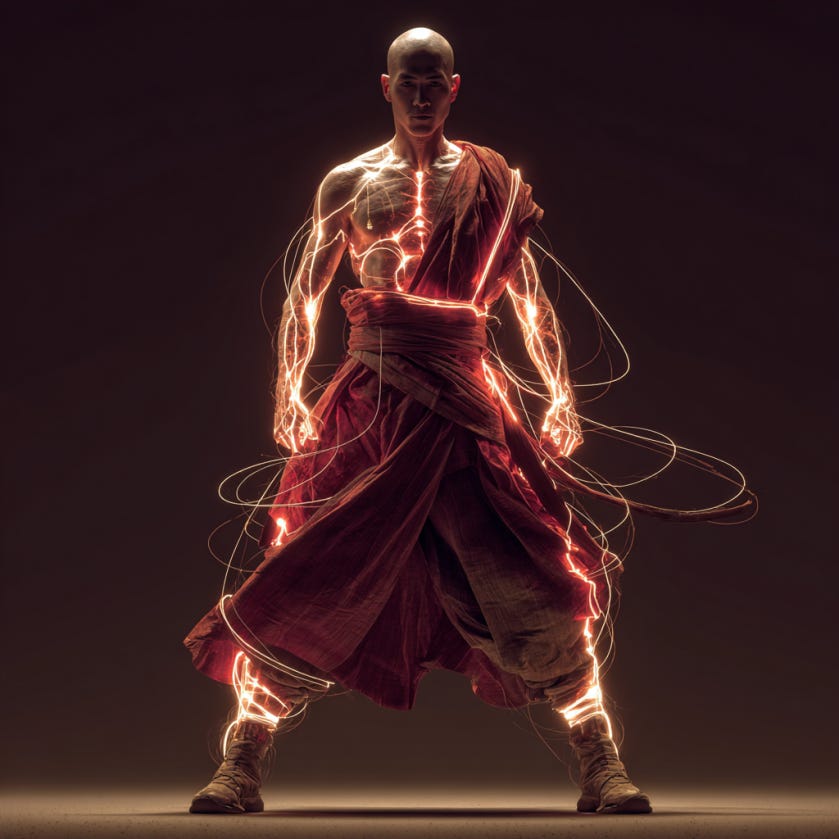
According to decades of studies, and basic common sense, wisdom is one of life’s most desirable attributes.1 Wisdom means knowing exactly what to do, and when. Perhaps the single most surprising concept that has emerged from the last few years of my studies of wisdom has been the importance of “subtle power.”2 For example, acting with a precise sense of your energetic relationship with the world appears to be critical to living a flourishing life.3
Our nervous system, our internal energy grid, is essential to detecting and holding this subtle power. And yet the West pays scarcely any attention to deliberately upgrading it. My guest, Andrew Markell, claims that Yiquan may provide a potential answer. Yiquan is a Chinese fighting and healing discipline that traveled through Tibet and was later refined by master Wang Xiangzhai. After three decades of direct practice and teaching, Andrew believes it offers a systematic method for developing our nervous system capacity. You can listen to our interview on Spotify or Apple Podcasts.
In his early twenties, Andrew traveled to Nepal to study Buddhism and climb in the Himalayas. As a speaker of Nepali, he was taken in by Tibetan Buddhist teacher and meditation master Choki Nyima Rinpoche. Unlike the Westerners who were taught calming “cold meditation,” Andrew was introduced to “hot meditation,” a discipline aimed at expanding your nervous system capacity. This practice was so deceptively powerful that the Tibetan monks and nuns have preserved it as an “in the home” teaching, to shield it from misuse.
On returning to Oregon, Andrew injured himself climbing and sought out a Chinese martial arts teacher, Gregory Fong, originally just for physical rehab. One day he witnessed Fong display an effortless speed and power unlike anything he had ever seen before, and decided at that moment that this was something he needed to learn. In a synchronicity connecting him right back to his training in Nepal, it turned out that Gregory Fong had also spent his entire life immersing himself in the art of Yiquan.
Like all good martial arts teachers in the movies, Gregory ignored him for the first two years of his training. Eventually, Andrew was allowed to study under Gregory for the next 25 years. Andrew has spent the three decades since training and teaching Yiquan to athletes, fighters, leaders, young people and Special Forces operatives. The key to Yiquan is described in Andrew’s particularly well-written introductory PDFs:4
The body holds secrets of power generation that modern training methods rarely touch. While most physical development focuses on muscular strength, there exists a more sophisticated system capable of producing speed and power simultaneously: the integrated network of tendons and neural pathways that, when properly awakened, transforms human physical capacity. This understanding is so rare that even among martial and wisdom traditions, it has been carefully preserved and transmitted only under specific conditions.
Yiquan starts with “standing practice.” This involves holding positions that place a significant amount of tension on your body, which then creates subtle internal pressures that begin awakening the body's deeper support systems. Where most people unconsciously rely on major muscle groups for stability, this practice immediately begins shifting load to the intricate network of tendons and smaller muscle groups that typically lie dormant. I have been training with Andrew for several weeks and I can confirm that it is remarkably challenging work. You stand in positions that immediately cause muscle trembling and rapidly make me think about Dune’s Paul Atreides putting his hand in the box of transcendent pain.

In the West, we typically either choose practices that fire-up our nervous system (cold plunges or breathwork), or slow it down (meditation). This is like rapidly oscillating the power we run through our grid without ever upgrading its capacity. As a result, many of the people Andrew works with have fried, or are on the path to frying, their nervous and adrenal systems. Instead, Yiquan actively builds the capacity of your nervous system, without relying on adrenaline, so that it benefits from incremental stress. This makes it classically antifragile rather than merely resilient.
Does it “work”?
I haven’t been training with Andrew long enough to take a definitive view on if his approach “works.” But one of the veterans Andrew has been training for the last year confirmed to me that he’s been seeing notable energetic and physical benefits. Either way, I believe any practice that enhances your ability to safely tolerate extreme discomfort is useful. More specifically: Yiquan trains your will.
I am slightly ashamed to say I have relatively little patience for “slow” spiritual practices. However, I believe a world full of intense food, stimulants and social media distractions requires equally intense training. Andrew describes this as “world as dojo.” Yiquan matches this: standing practice will get you to laser focus through burning discomfort in seconds.
Despite my impatience in the moment, I also understand the benefits of committing to intense pursuits for the long term. I am into my fifth year of Brazilian Jiu Jitsu training, roughly 5,200 rounds of grappling, and am still very much a beginner. As someone regularly pretzeled by black belts half my size, I viscerally understand what encountering true subtle power feels like. This also points to another proof point of Andrew’s claims: you can either hold these stress positions and demonstrate power, or you can’t. There’s no debate. As they say in BJJ: the mat doesn’t lie. Good luck pretending to be a black belt.

Yiquan’s benefits allegedly go well beyond fighting. Andrew claims to have observed that recruiting tendons and nervous system capacity activates a great deal of hidden potential and awareness. He believes this confirms what ancient Tibetan practitioners recognized and documented through their own practices: that this approach to training allows for greater access to subtle energy. Fascia, when properly stimulated, becomes more electrically conductive. As our nervous system capacity expands, so do our subtle senses like pattern recognition.
My recent conversation with developmental expert Peter Merry catalysed a fresh insight for me. A relatively safe and abundant environment allows for the freedom for you to evolve your subtle senses. But it’s often an increase in the complexity of your external environment that requires the evolution of your consciousness. For example, I initially thrived in an “orange” achievement-based Wall Street environment. But as my life and career stagnated, I needed to cultivate my intuitive sensitivity in order to pursue a more integrated life path. But my consciousness hadn’t yet evolved enough to be able to detect those kinds of subtle energetic signals. As a result my psyche may have generated a spontaneous “awakening” experience. This involved a temporary, massive expansion in my sensory abilities. For a few days afterwards I could hear leaves rustle on the trees a hundred feet away, I could see subtle energy licking off their branches, I could even feel the emotional states of others if they came within a few feet of me. I also acquired what felt like a precognitive sense of all-encompassing pattern recognition, and I am still integrating those insights eight years later. However, without the nervous system capacity to hold this new power, I quickly burned out like a lightbulb connected to a nuclear reactor.
A radically more complex world now requires significantly higher capacity for subtlety. This also means we might have to upgrade our nervous systems to handle those increased energetic demands. If Andrew’s right, practices like Yiquan can fill a gap that’s generally totally neglected in both spiritual and athletic training alike.
For those interested in learning more about Yiquan, at The Dawn Collective. You can listen to our interview on Spotify or Apple Podcasts.
A recent study found that “Wisdom is the best predictor of life satisfaction in both men and women and can offset the influence of negative age on life satisfaction. Wisdom has a greater influence on life satisfaction in older adulthood than health, socioeconomic status, financial situation, environment, or social engagement.”
Thirty years of wisdom research has shown that it correlates with hedonic wellbeing (how good you feel) and eudaimonic wellbeing (how much you’re growing). Wisdom means always knowing what’s most important, what to focus on in every different situation. This means the pursuit of wisdom both reduces your anxiety and increases your sense of purpose. In short; wisdom is the ability to pursue what you love and ignore what you don't.
The importance of subtle power was the central takeaway from last year’s Accelerating Wisdom Series.
Check out my recent interview with Emily Lane on Accessing Evolutionary Intelligence.
I practice internal martial arts (Nei Kung) and can attest to their benefits. Some books/resources you may find useful:
1. Encounters with Qi. Written by David Eisenberg when he was a student at Harvard Medical School, who went to study in China and got access to some very high-level qigong practitioners. Describes many of the strange and interesting phenomenon he observed.
2. Mysteries of the Life Force. Explores similar themes as Eisenberg's book, but this is more of a "practice log" of one student who apprenticed under a qigong master.
3. Opening the Energy Gates of the Body. This is written by Bruce Frantzis who is probably one of the most highly-attained contemporary internal martial artists. It focuses on Nei Kung (related to, but slightly different than Yiquan). Extremely practical and detailed introduction to the foundational exercises to develop internal power.
Als recommend spending time in the The Dao Bums forums. Gold mine of information if you read posts by some of the legitimate masters.
Fascinated with internal martial arts. Life-changing stuff. I could go on and on about resources, stories...but wanted to keep the comment short.
I’ve done a bit of standing practice in Tai Chi, where one teacher told me it’s the fastest way to build the subtle energy capacity of the body. But I’ve heard that Yiquan places a much greater emphasis on standing as opposed to the long, flowing forms that Tai Chi spends most of its time on. I’ll be curious to hear how the training goes for you in the coming months.