

[This article has a 3/10 Woo Rating].
If the purpose of our existence is the evolution of our consciousness, then maps of human development are pretty important. Whether you like it or not, these models probably apply to you. So it’s best to know where you might be and what might be coming next.

There are lots of amazing articles1 describing developmental maps and the specific stages themselves, so this one will be more about why the maps themselves are important. I believe the most valuable commonality is that they don’t just imply a direction to the evolution of consciousness, they try to describe what that process looks like on the societal and individual level. That probably sounds obvious, but how many people in your daily life do you feel are deliberately working on the evolution of their own consciousness? And how many have an accurate sense of their own relative trajectory?
The most influential and credible maps share a broad agreement of what that process looks like. One of the more robust models is Spiral Dynamics. I interviewed Peter Merry, an author, Co-founder of Ubiquity University and Wyrd Technologies and an expert in Spiral Dynamics. He gave us a relatively quick guide to developmental frameworks and then a deeper discussion of where we are now, as well as what this moment’s new kind of emergent leadership might look like. [Listen on Spotify or Apple Podcasts].
As a quick recap for people unfamiliar with the spiral dynamics map, these are the basic stages:
Beige: Focused purely on survival, driven by instincts and basic needs like food, warmth, and safety.
Purple: Tribal and magical, seeking safety in groups and rituals, guided by spirits, elders, and ancestral ways.
Red: Egocentric and power-driven, asserting dominance and immediate gratification through strength and force.
Blue: Orderly and rule-bound, often rooted in religion or authority.
Orange: Rational, strategic, and success-oriented, valuing achievement, science, and personal advancement.
Green: Focused on inclusion, empathy, and harmony with others and nature. Postmodern and relativist.
Yellow: Integrative and flexible, able to see multiple systems and truths.
Turquoise: Holistic and cosmic, sensing unity of all life, embodying global consciousness and the flow of evolution itself.
Peter has a helpful framework for how each stage might respond to a new idea.
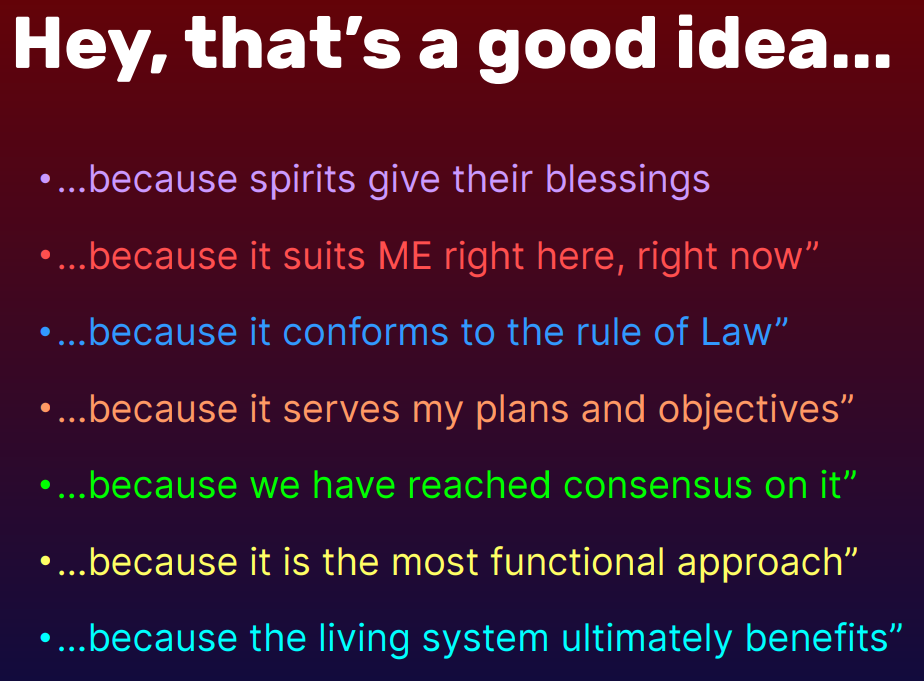
The more our basic needs are met, the more freedom we have to see the world in subtle and nuanced ways.2 One way this manifests is in the complexity of our perspectives. And an easy way to test ourselves is to consider our own emotional triggers. These can be people in our daily lives, or polarizing public figures like Donald Trump, Elon Musk, Vladimir Putin or Hilary Clinton. A less integrated view tends to place people and topics in binary “good” or “bad” categories, more integrated levels see room for complex motivations and common human flaws.
And yet: if you then find yourself looking down on other people who think in less nuanced terms, that’s also a symptom of an earlier stage. This is because seeing the stages as a hierarchy to climb is typical of the achievement-based stages. Instead, they are a holarchy, which is why a better way to envisage them is as a rainbow onion. The inner color layers are the more basic needs. You cannot skip a stage and you make progress by transcending and including the prior levels. Your circumstances can also push you back down a stage. We are all only a few missed meals or bad nights’ sleep from dropping down to more basic survival concerns. This stages perspective can also help you to be more compassionate about your own “college atheist,” “over-achiever,” or “spiritual bypasser” phases.

One very helpful guiding principle taken from these maps is to look back at the trajectory of your own life as a holarchy. Your educational and professional experience can provide increasingly sophisticated skillsets. These are then ideally transcended and included in an integrated way in service of emergence. What’s funny is that this process is usually only obvious looking backwards. The disciplined structure of school and college taught me basic reading, writing and analytical skills (Blue order stage). On Wall Street I learned how to spot key insights and communicate them rapidly (Orange ambition stage). In the decade that followed I became interested in more holistic topics (Green). Then I started to see wider systemic patterns and tried to align my life around them. Now I strive to integrate all of these skills to run a community and produce content around what brings me alive. [I’m obviously implying I’m Yellow or Turquoise, but that also obeys the first law of stage theory: people who enjoy these kinds of maps always seem to think they are further along than they actually are].
Arguably the most important perspective you attain at the more integrated levels is that you recognise the force that is driving the process itself and find ways to align with it. Although the framing definitely has a hierarchical tone, Ken Wilber’s Integral Theory makes a distinction between Tier 1 and Tier 2 thinkers.3 Tier 2 begins with the Yellow level and it’s the first perspective that understands all the previous ones as valid steps in development, then transcends them. The shift from Tier 1 to Tier 2 is a profound phase transition in your worldview. At Tier 2 you not only understand what’s making the onion grow, you can begin to work with that force. Donella Meadows called this “dancing with systems.” Or, as Integral Theory’s Ken Wilber puts it:
“Spirit is both the highest "level" in the holarchy, but it's also the paper on which the entire holarchy is written. It's the highest rung in the ladder, but it's also the wood out of which the entire ladder is made.”
There are signs that this shift may be emerging in society as we speak.
Is “THE SHIFT” Actually Happening?
If everything is progressing towards complexity, it makes sense that our cultures and societies are subject to the same forces. As Peter notes, the journey each human goes on in the course of their individual life mirrors the same journey humanity has been on for hundreds of thousands of years.
If the stage we can reach is partially determined by our environment, more of us should now have the potential to reach later stages. Most of you reading this have access to a level of resources and information that was unthinkable even a few decades ago. High quality soil means more onions can grow faster. And, as Peter noted in our conversation, a change in our environment doesn’t just make new stages possible for us, an increase in the complexity of our situation often requires a new stage in order to operate successfully in the world. How would a caveman handle holding down a job and raising a family in Manhattan? As the world has exponentially increased in complexity over the past few years, the evolutionary demands on our consciousness have increased accordingly.
Whether it’s Blue’s dogmatic religion/monarchy, Orange’s scientific materialism/capitalist individualism or Green’s postmodernism/relativism, all of the previous control systems and explanatory models are failing. This is because they cannot hold the complexity required of our current circumstances. But thanks to these stages models, we can guess what’s coming next: a deeper understanding of intelligent forces that transcend and include every stage we’ve had before.
However, it’s a very common feature of people who have had sudden spiritual or psychedelic experiences to assume we are on the verge of a global shift in consciousness.4 There’s even a word for it: “eschatothesia.” Specifically, we are currently seeing newly-spiritual finance and tech professionals use their elite pattern recognition skills to produce evidence that we are on the cusp of a global awakening. Confirmation bias is a helluva drug.
Transformational coach and Integral Theory expert Devin Martin gave a short, insightful and amusing talk at the Leading Edge Summit. He poked fun at the sheer volume of newly-spiritual executives he encounters who are experiencing eschatothesia (especially me).
However, he agrees that there is definitely something unfolding. He sees the current global distribution as relatively concentrated in the order and ambition stages, but with a very small number of people now emerging around the later levels.
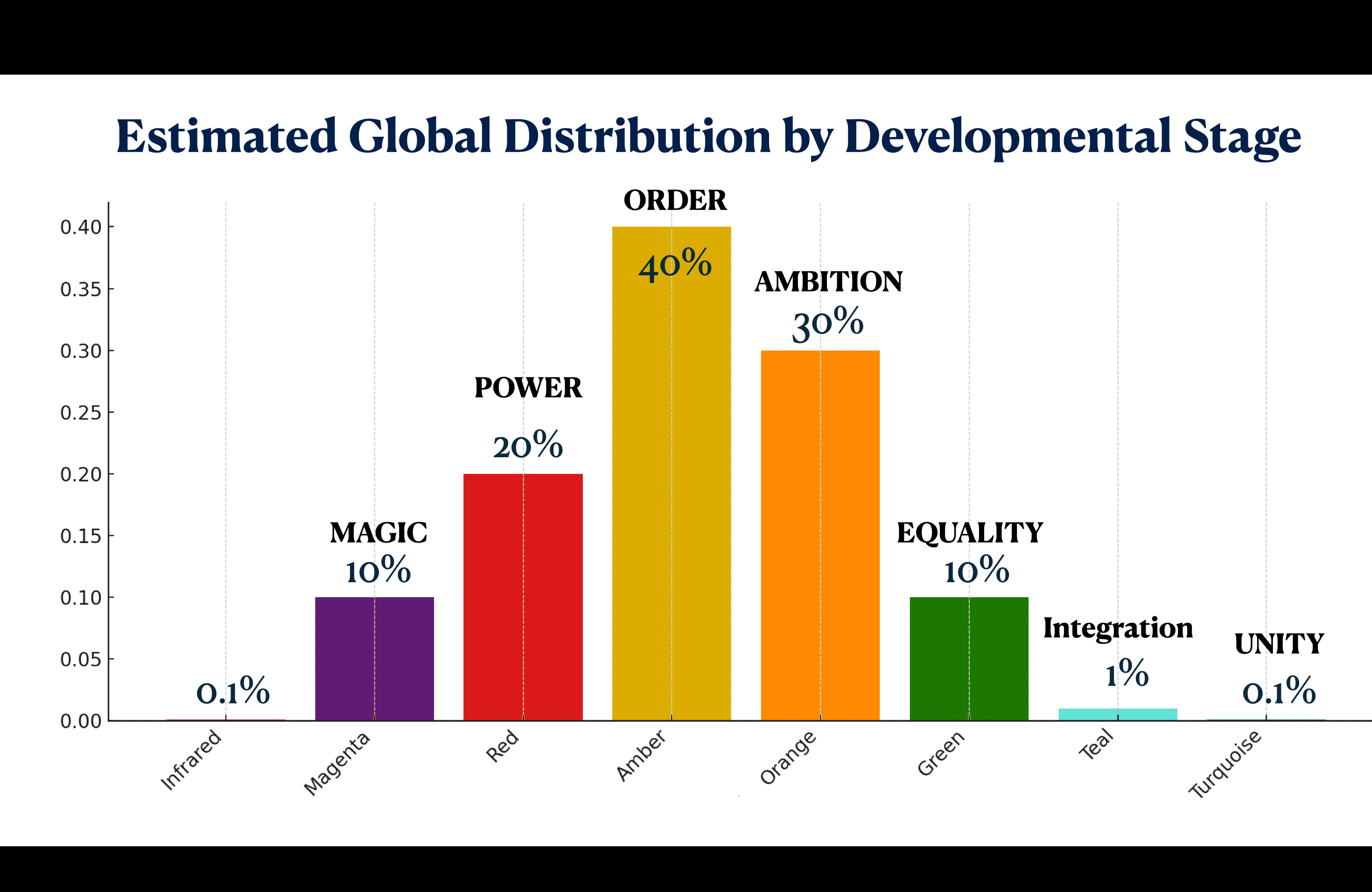
Even more interestingly, he notes that we seem to be moving into the integrated stages at an ever-accelerating rate.
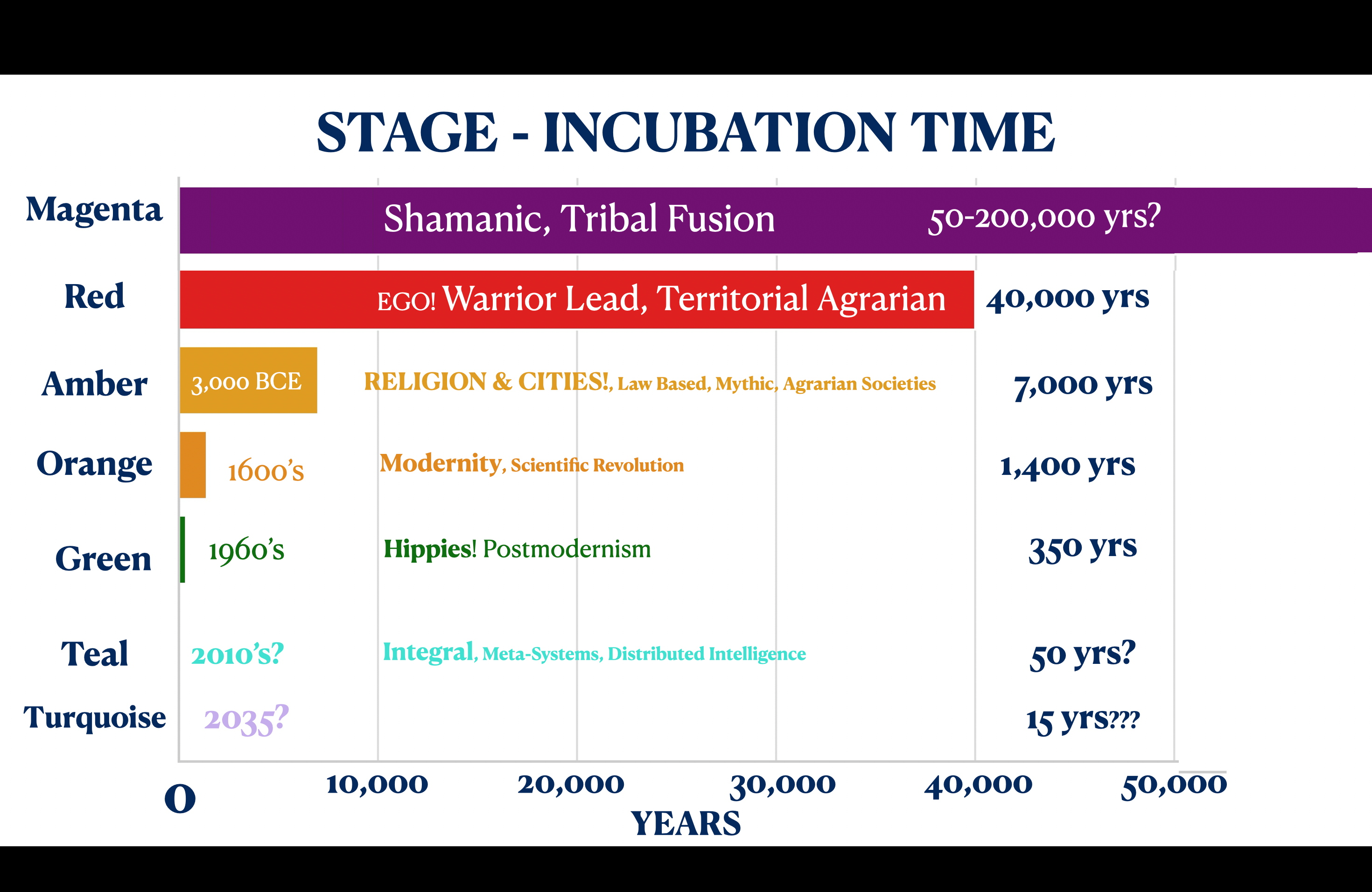
Timeframes accelerate as you approach tipping points, and there are a whole range of theories floating around offering percentage thresholds for when a global shift in consciousness might occur.5 I have argued that this paradigm shift will be marked by the realization that, not only is consciousness primary, it has an evolutionary direction. Once again: you not only understand what’s making all of the onions grow, you can begin to work in alignment with the direction of that force.
I’ve long wondered how we’d know if this wider shift in perception was actually happening. So I consulted with neuroscientist and author on the science of spirituality Mona Sobhani, PhD. I asked her for a definition of what it might look like. She believes that this shift could take many forms in society, but one possible expression is a growing acceptance that mystical, anomalous, paranormal, or spiritual experiences are real and should be taken seriously.
How might these phenomena be relevant to stage theory? One example would be Near Death Experiences (NDEs), which consistently produce a sense of your consciousness no longer being bound to your physical form. It also explains why Out of Body Experiences (OBEs) have been central to shamanic and mystery school initiations for thousands of years.6 Suddenly you’re above the whole garden looking down at the onions. The immense benefit of exploring a mystical worldview is that it makes us receptive to the kind of intelligent forces we encounter at the more integrated levels of consciousness. This is analogous to the shift in perspective to Tier 2 where you no longer solely identify with the stages themselves, but also the force that’s driving our growth through them.
It’s easy to see how this transition to Tier 2 can come with a loss of interest in careers and topics that dominate the less integrated tiers. Moreover, an existential crisis is pretty likely as we increasingly disidentify with the “Tier 1” egoic and societal structures that we’re now transcending. If Devin’s chart is accurate about the tiny global distribution of the more integrated stages, there also won’t be many other people around you that share these emerging interests, which can be lonely and disorienting. And yet, to be increasingly dissatisfied with life at the “ambition” stages isn’t a lack of gratitude for material abundance, it’s heeding the call of evolution. According to many of these models, the more you’ve reached a stage of material sufficiency, the more open you might be to subtle evolutionary signals. The alternative to swimming with the current is drowning or stagnation.
Anecdotally, this shift in perception is definitely happening within my personal orbit, and even on Wall Street. And while it’s obviously subject to the same forces of confirmation bias, Peter Merry and I agree that the mainstreaming of spiritual practices, psychedelics, psi phenomena and post-materialist scientific theories provides a broader supporting case.7 But empirical data on this has been much harder to come by and I’ve yet to see anything vaguely compelling in either direction.8
The key question for individuals in the context of these transitions is: what do you do at the later levels. One answer that seems to consistently produce emergent flourishing is to work with the force that’s growing the onions.
Leader as Gardener
A common rebuttal to claims that “the shift” is happening is that certain Western democracies seem to be slipping back into less integrated political landscapes. But even if the tide isn’t rising for all, individuals still definitely have increasing agency to embrace the more integrated forms of consciousness and leadership.
As Peter describes, Yellow leaders can still get stuck looking to engineer big systemic solutions to massively complex problems. Instead, Turquoise looks to become so present in the moment it makes wise single steps in harmony with the system. This requires cultivating an embodied sense for the energy of the system you’re in. The force that’s growing the onions is fundamentally subtle. It’s why you can only detect them at higher levels of integration, likely when your other basic needs have been met. Leaders make space for that force to emerge and cultivate that sensitivity in others by making them feel safe. This extends the walled garden analogy. These intimate containers and communities can provide superior conditions specifically for the evolution of consciousness.

Unlike the more overt earlier stages, this kind of leadership doesn’t develop more control structures, as a gardener it facilitates the subtle conditions for emergence. This can be as simple as ringfencing a business unit, running a conscious community or working 1:1 on personal development. Over the last 18 months at The Leading Edge we’ve been slowly building a resource base for this new generation of leaders.
We have been innovating on a template for World Wise Web communities for high-agency people.
Brian Whetten has helped us identify the most likely ways these communities fail while outlining frameworks for success as both individual coaches and authentic leaders.
As Peter repeatedly emphasizes, gardener leaders are attuned to the subtle energy of the system they are a part of. The most efficient description of this sensititivity is “wisdom.” I spent all of 2024 researching a series on accelerating the evolution of your consciousness. We emerged with 11 key practices and tools. I have subsequently spoken to multiple experts on how to harmonize with evolutionary intelligence, build a meditation practice and cultivate embodiment, intuition and subtle presence.
Money, and perceptions about money, remain the overwhelming obstacle to the evolution of consciousness. So we have covered the integration of money both personally and systemically. We are also dedicated to exploring how we evolve beyond “Orange Capitalism” to “Turquoise Sageism” in practical ways.
The metaphor Peter likes to use is that, when a caterpillar is becoming a butterfly, new “imaginal cells” emerge. These are initially attacked by the old system, but when they first connect to each other and then persist, the old form dissolves and fuels the new. The butterfly must then struggle against the walls of the cocoon until it eventually has sufficient strength to survive on its own. The new generation of leaders will build these spaces.
[Listen to my conversation with Peter Merry on Spotify or Apple Podcasts].
I’d especially recommend: Bodhi’s The Map of Our Future “I’ve now decided that Tara Springett is my favorite recommended teacher for anyone seeking a path to higher consciousness. Her blue book changed my life and as I’ve revisited her many other books I’ve come to conclude she has simultaneously provided both 1) the most comprehensive teachings and 2) the most practical applications of anyone I’ve encountered. Yes, there are other mystics with far greater abilities or more captivating stories, but no one makes it as consistently accessible and practical as Tara.”
Kyle Kowalski has written a comprehensive summary of Ego Development Theory.
James Taylor Foreman wrote a great piece on his own personal progession through the stages, although we’d differ a little on what Stage 7 looks like.
As I explored in Fear, Fortune and the Fog of War, a safer environment might literally change what we are able to perceive. It’s a wild idea. Moreover, if consciousness were getting increasingly subtle, we might also expect to see a spike in the sensitivity exhibited by younger generations. This might be reflected in rises in neurodiversity. As recently discussed in Evolution and Psychiatry, Neuroscientist Dr. Anne-Laure Le Cunff has developed a “Hypercuriosity Theory of ADHD.” More freedom translates to a high exploratory instinct and sensitivity to novel topics. A draw to pursue unique niches appropriate to our gifts. But in an outdated system optimised for a small number of careers and low-level of neurodiversity, this can just look like high distractibility and impulsivity.
Mark Manson wrote a stinging critique of how Ken Wilber’s Integral Movement got corrupted by falling back into hierarchical thinking.
There’s also the “states and stages” problem. It’s possible to experience fleeting transcendent nondual states at a less integrated level of development. You might then interpret the experience at that level of development; for example, someone at the egoic ambition Orange stage might be at risk of assuming they are personally the messiah. There’s a big difference between have a Tier 2 “state” peak experience of transcending the ego and actually living from that place as a “stage.”
I’d recommend one of the best podcasts of the year so far with Martha Beck and Scott Britton on this topic. Also his article What’s Actually Happening With The Consciousness Shift on the Planet?
Check out my recent piece on the mystical history of Portugal and my interview with Freddy Silva. Appropriately, my last guest Emily Lane had an NDE after drowning in Ecuador that was the gateway to a gradual awakening process over two decades. Funnily enough, Peter also agrees with the general need for us to reunite with the divine feminine, something he described in his viral article Volution – the Pain and the Promise.
I’ve recently been down an enjoyable rabbit hole with Federico Faggin’s theory of Quantum Information Panpsychism. I don’t understand it all, but it seems approximate to the kind of theory that transcends materialism.
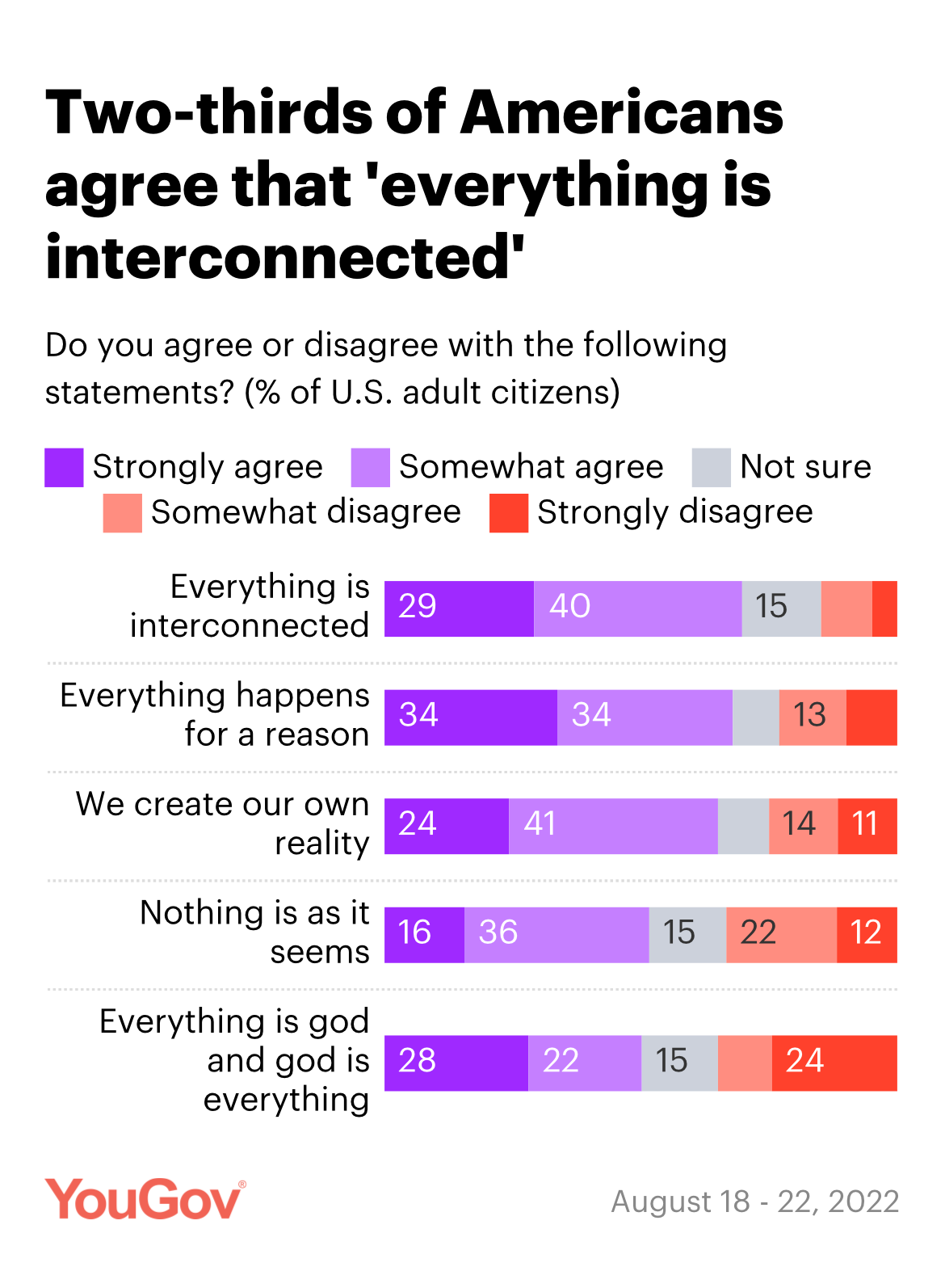
There’s a pretty decent YouGov poll showing how surprisingly prevalent “New Age” beliefs are among Americans, but it isn’t offered as a time series.
So delighted to read this today, especially as Mr Merry crossed my thoughts in meditation at essentially the same time you sent this. More evidence of the field LOL!
It's also quite a revelation, because I first picked up on "the Shift" topic decades ago, but for most of that time thought we were eons away from it. I never stopped stewing on the question (would I see the shift in my lifetime) but never had a sense it was anywhere close.
But something has changed in the last few years.
Not just in myself but also the observable environment. Also decades ago, McKenna talked about "the strange attractor at the end of time", something the Master Psychonaut would wax poetic on endlessly, creating a compelling image of some mysterious magnetic force, pulling us inexorably towards a profound, but undefinable omega point. How this force has defined itself for me personally is a relentless pursuit of consciousness evolution as if it's the ONLY thing that matters.
Because it IS.
I'm probably 10/10 woo as Turquoise and was really excited to come across your article about Spiral Dynamics. It's one of the subjects I'm most interested in but it's so niche I rarely find content about it, or people to talk about it with. I agree Turquoise seems to be the leading edge of development and as more people end up there, I think more "New Earth communities" will form which will offer an alternative to the current system.
Also, I'm not sure if you're familiar but there are four levels above Turquoise (definitely marginal in terms of percentages, but still interesting). This is the best source I've found, from someone who's experienced them: https://www.youtube.com/playlist?list=PLuA_MsJsA-_ZAE8AqiRyBbRrF6tbFsSMe