

A common knowledge event isn’t when everyone knows something. It’s when everyone knows that everyone else knows something. My favorite example is when the Romanian dictator Nicolae Ceausescu was booed by a crowd on a balcony during a televised speech. Although each individual person knew they disliked him, they didn’t know for certain that everyone else did too. This common knowledge event brought down his regime within days. I feel we are approaching the same moment, but the tyranny is a rigid and outdated map of reality.
I currently meet somewhere between ten and twenty new people a week. The topics are typically life transitions, curiosity, and bringing forth more of your potential. A remarkably common feature of all of these conversations is that the person I’m speaking to holds a mystical belief and thinks it is still deeply taboo. Many of these people have had life-changing nonordinary experiences, some of which they have been told were just features of mental illness. This isn’t your typical “spiritual” folk either. It’s people working in mainstream jobs in major cities. Culturally, we often use “woo” in a dismissive way to indicate a lack of intellectual discernment and rigor. But what if these leading edge perspectives were actually widely (but secretly) held by intelligent and successful people?
I think breaking this taboo is radically important, because if people are working with incomplete maps, they can get stuck in bad places.
So I put together a four-minute, 30-question survey, “How Woo Are You.” You can try it now and it will also categorize you into some fun buckets as to how you might view the world. The idea was to see how widely held an array of mystical beliefs actually are, and to line the beliefs up from the most mainstream to the most "out there."
I put it out to my followers and the members of Leading Edge. The results were pretty interesting.
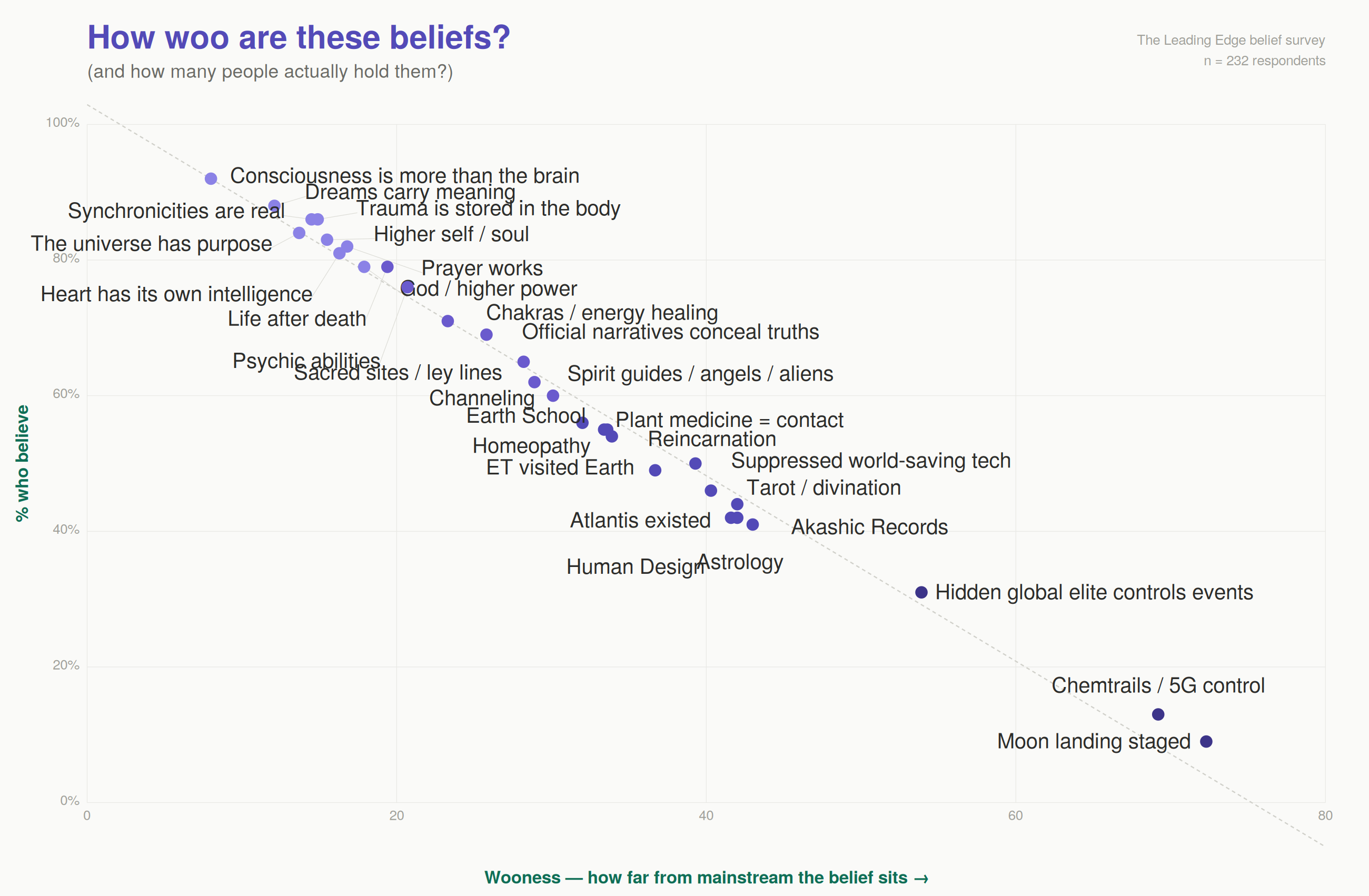
What I would define as the most "practical" non-traditional beliefs are also the most widely held. That consciousness is more than just the brain (92%), that dreams can carry meaning (88%), that meaningful coincidences are real (86%), and that the universe has some kind of purpose (84%). I believe these are all the kinds of beneficial beliefs that open you up to intelligent guiding forces.
The less immediately practical, conspiracy-type beliefs are the least common overall. But the more spiritual a person is, the more conspiratorial they also tend to be. "Conspirituality" shows up clearly in the data.
If you could ask only one question to predict how "woo" someone is overall, it would be whether they believe in channeling. It's the single most telling belief (a correlation of 0.83 with someone's total score), followed by the Akashic Records (0.82) and spirit guides (0.79).
There is obviously a reasonable selection bias (under 30% of the respondents were classified as skeptical). But the fact is, I know my community well and, to a lesser extent, my subscriber base, and they are also pretty sober and discerning people.
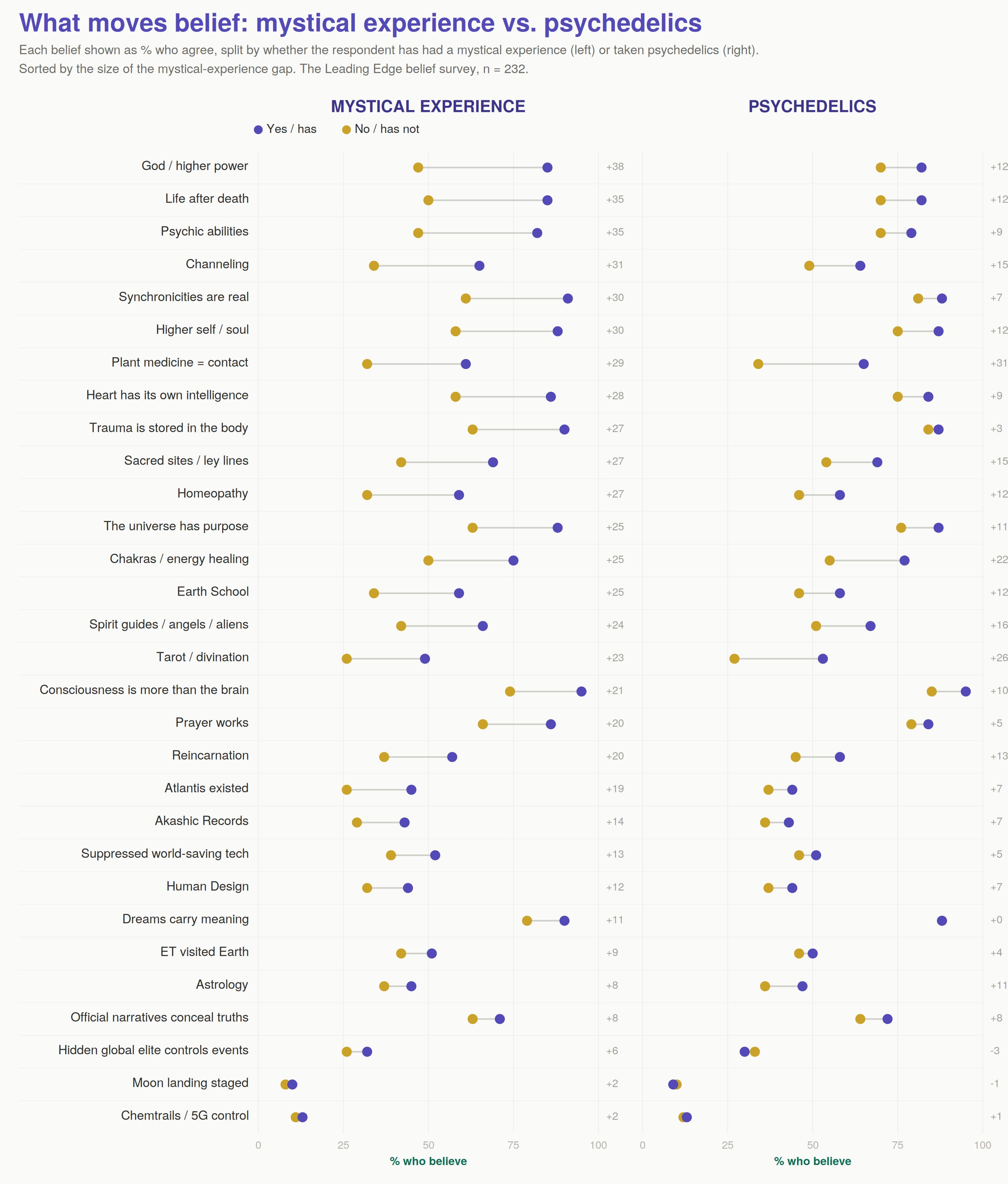
At the start of the survey, I also asked respondents if they have had either a mystical experience1 or taken a psychedelic, in order to see how much it might alter their worldview.
Mystical experience lifts almost everything. People who’ve had one are far more likely to hold nearly every belief on the list; led by God (+38 percentage points), life after death and psychic abilities (+35 each), and then synchronicities and channeling (+31). The effect is broad: mainstream spirituality, healing, and esoteric beliefs all rise together. Only the conspiracy items at the very bottom stay flat. So a mystical experience seems to open people up to spiritual belief specifically, not to believing anything and everything. Phew.
Psychedelics are more selective. They lift some beliefs sharply and others only a little. The big movers seem to be the hands-on, body-based beliefs; plant medicine as a doorway to other intelligence (+31), tarot (+26), chakras and energy healing (+22). The more abstract, head-level beliefs rise too, but more gently — God (+12), the universe having purpose (+11). So where a mystical experience raises the whole spiritual spectrum at once, psychedelics mostly boost a specific, embodied cluster. But they also seem to be starting from a higher baseline. That’s probably not too shocking: if you’re the kind of person open to taking a psychedelic in the first place, you’re likely more mystically inclined than average to begin with.
In our 232-person sample, 84% reported having had a mystical experience versus the US national average of 49%,2 and 71% reported psychedelic use versus a national lifetime rate of roughly 28%.3 But the fact that nearly half of Americans report having had a mystical experience is something that implies to me that these “woo” beliefs are held by more people than you would commonly expect. Interestingly, of the 194 people who’d had a mystical experience, only four (!) stayed skeptical afterwards.
One fun take-away from this, which has been confirmed by my own lived experience, is that the person opposite you, making polite small talk, probably has had a non-ordinary experience that’s they’re secretly dying to share with you. But each is worried that the other person will think that they are crazy. In my experience running Leading Edge, too many people feel loneliness about those transcendent experiences. And yet, they often rate them as one of the most meaningful moments of their lives. Imagine if you had to keep your wedding day or the birth of your first child a secret? Once they find out what I’m working on, I’ve had people I’ve known for years open up about synchronicities, past life memories or their psychic abilities. Our members are drawn to us through curiosity and the desire to discuss exciting topics with a grounded peer group. This shared connection about the things that truly matter means that these relationships become deep and loving very quickly.
“Love is mutually accelerating disclosure.”
-John Vervaeke
“Broadly defined: a sudden sense of unity or oneness, a feeling of contact with something beyond ordinary reality, ego dissolution, a moment of overwhelming awe or presence — regardless of the context it happened in.”
About 49% of the U.S. public says they have had a religious or mystical experience, defined as a "moment of sudden religious insight or awakening." This figure has climbed steeply over the decades — it was only 22% in a 1962 Gallup poll, rose to 31% by 1976, sat around 33% through 1994, and reached 47–49% by the late 2000s. The exact number depends heavily on how the question is worded: a broader phrasing yields much higher rates. A 2023 Pew survey found 45% say they have had a sudden feeling of connection with something from beyond this world, and 30% say they have personally encountered a spirit or unseen spiritual force. With a very broad definition the figure climbs further still.
A 2022 YouGov poll found 28% of Americans have tried at least one of seven psychedelic drugs, with LSD the most common (14%) followed by psilocybin (13%), MDMA (9%), mescaline (8%), and smaller shares for ketamine, DMT, and salvia. An academic analysis put lifetime use of any hallucinogen from 2002–2019 at 14.9%, with LSD at 9.6% and psilocybin at 8.4% — lower than YouGov, mostly because it predates the recent surge and used a narrower drug list. And use is rising fast: a federal survey found 10.4 million Americans used psychedelics in 2024, a 37% increase since 2021
Really pleased you’re writing about this, Tom. I did the survey and was keen to see the results. It’s encouraging.
I left a senior leadership role in the corporate world last year. I was a lawyer before that. So I would describe myself as “sober and discerning” as you put it. I now live in Bali which has brought me closer to most of the things in the top half of your chart.
I always believed in synchronicity but most other things I can’t imagine talking to my past colleagues about, without wondering if it will undermine my credibility and make people think I’m having some sort of crisis!
And yet a greater awareness of all of these things - particularly somatic work and trauma stored in the body - is so desperately needed for people to feel more fulfilled in (or able to escape..) the corporate systems of the West.
I hope you’re right that we’re on the verge of a tipping point. It reminds me of the (supposedly) fictional book The Celestine Prophecy. The book talks about something similar happening and the benefits of a world where everyone is much more connected to themselves, their intuition and the energy around them. I’m excited to see if it comes true.
I love this! This just reinforces my growing belief of the changes occurring that are now opening, expanding and supporting the individual and collective awareness. What occurred to me as I read the results is the idea that all things are possible because of the infinite potentialities that lie within each of us, it's just a question of resonance - much like schools of yoga, meditation, martial arts, etc. these are all different modalities, which resonate more with some less with others, yet all end up leading to the same place. Ultimately, those of now "coming out" as Woo serve as bridges, lighthouses (pick your analogy) for others to feel safe enough to share, affirm and be. Can't help but grow increasingly excited as this continues to unfold....