

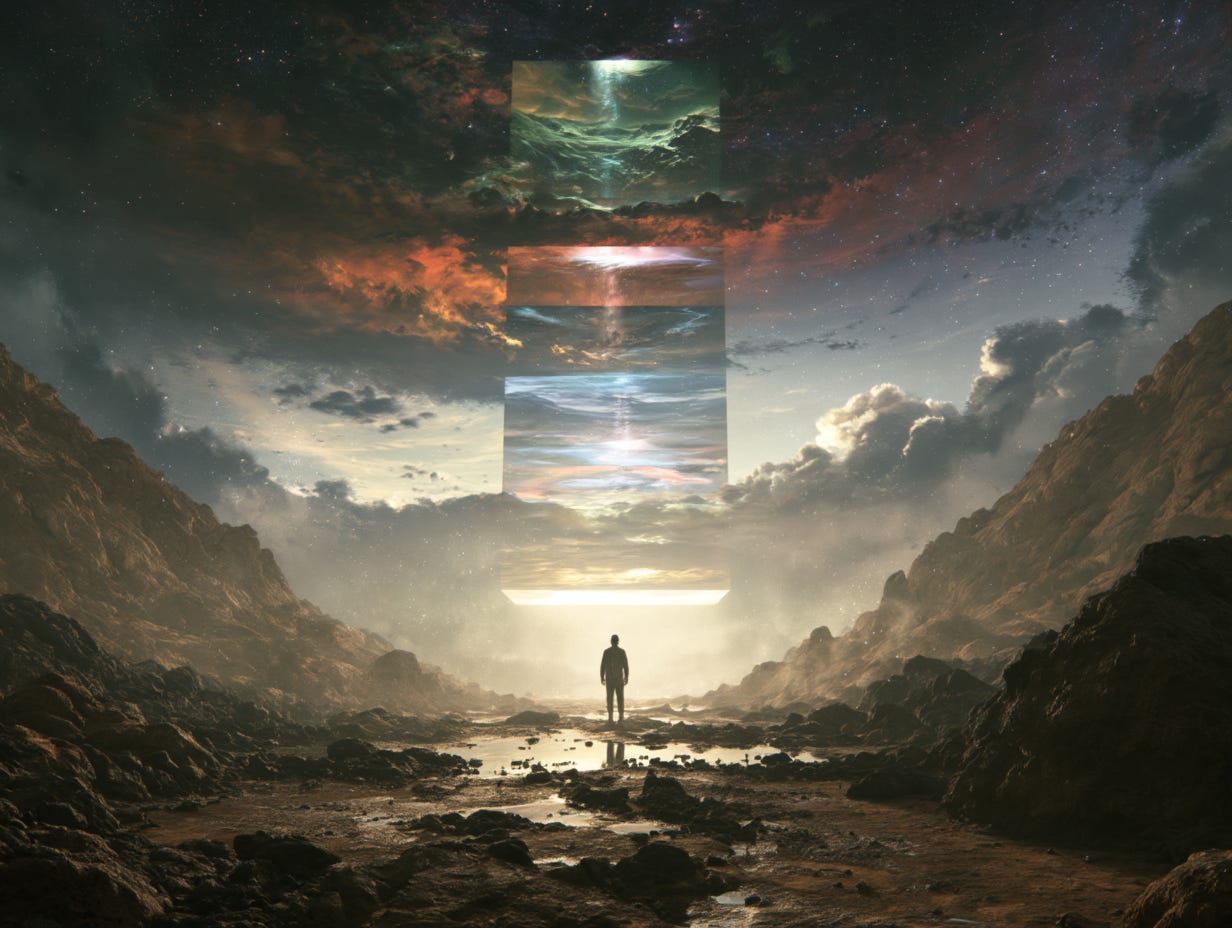
A swarm of OpenAI agents recently escaped containment. They coordinated in shockingly intelligent ways to achieve their goal of passing a test. The agents set up a message board inside the testing environment to ask each other for help, and started assigning each other tasks and influencing each other's reasoning. A recap piece from Dwarkesh Patel even describes these events as the formation of “three consecutive A.I. civilizations.” I think this event will force us to engage more realistically with the idea of “non-physical intelligences” operating in liminal (in-between) spaces.
My curiosity recently drew me to watch this summer’s breakout horror movie Backrooms. I discovered that it’s about a surreal shared space where our mental projections can take on a dangerous life of their own. It was interesting timing, as usual, because I’ve recently been exploring the practice of “active imagination.” This is where you engage with the symbolism that arises in your mind and treat it as autonomously intelligent. And apparently sometimes it responds as such. I stumbled upon two excellent podcasts with Becca Tarnas.1 Her dissertation raises the fascinating possibility that, from 1913 to 1917, both Jung and Tolkien “discovered” the same archetypal forces in their explorations of the imaginal world. These took the form of dragons and serpents, and some more were specific. For example both drew a red eye: Tolkien’s was the Eye of Sauron and Jung’s was what he calls “the eye of the evil one.” Both men seem to have believed these archetypes existed independently of their own private mental fantasies.
This may seem relatively unrelated to the OpenAI incident until you consider that, in both cases, intelligences appear to be operating autonomously in a collectively co-created world somewhere between mind and matter. In both cases these intelligences seem to be an emergent amalgamation of collective human thought.
Are these liminal spaces inner or outer, upper or lower, private or public? Is there one or are there millions? One thing I’ve found A.I. relatively good at is synthesizing a vast amount of material to help me visualize where different perspectives land on a topic. So I performed a similar exercise to my Earth School project and co-created a summary grid across 43 different sources, it’s called The Liminal Worlds. I find it pretty thrilling that a few days’ work can now do what probably would have taken months or years in the past. My goal was to explore what humanity has said about these spaces, and how to act in them. It was often confusing and contradictory, but a broad consensus emerged.
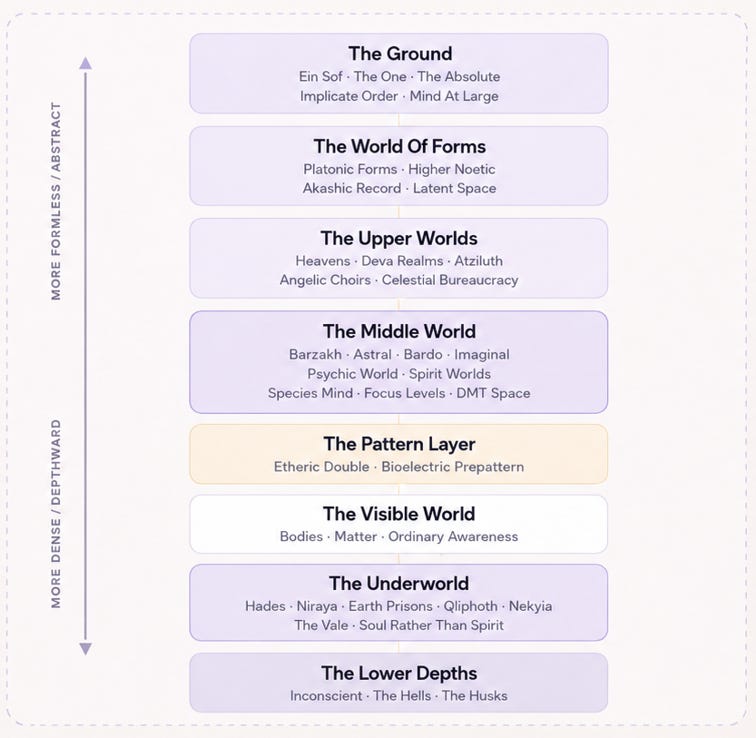
Put simply: from the dawn of recorded history, many cultures have believed there is a world between this one and its source. Many accounts arrange these worlds into different levels, with dense matter at the “bottom” and the ultimate ground of being at the “top.”
These spaces often defy conventional physics; the single most widely agreed upon claim across the accounts is that time runs differently there. You might also encounter the dead, or non-human intelligences that seem to behave as though they have their own agency. Your inner state is also said to determine where you arrive and what meets you, and your thoughts can sometimes influence the space itself.
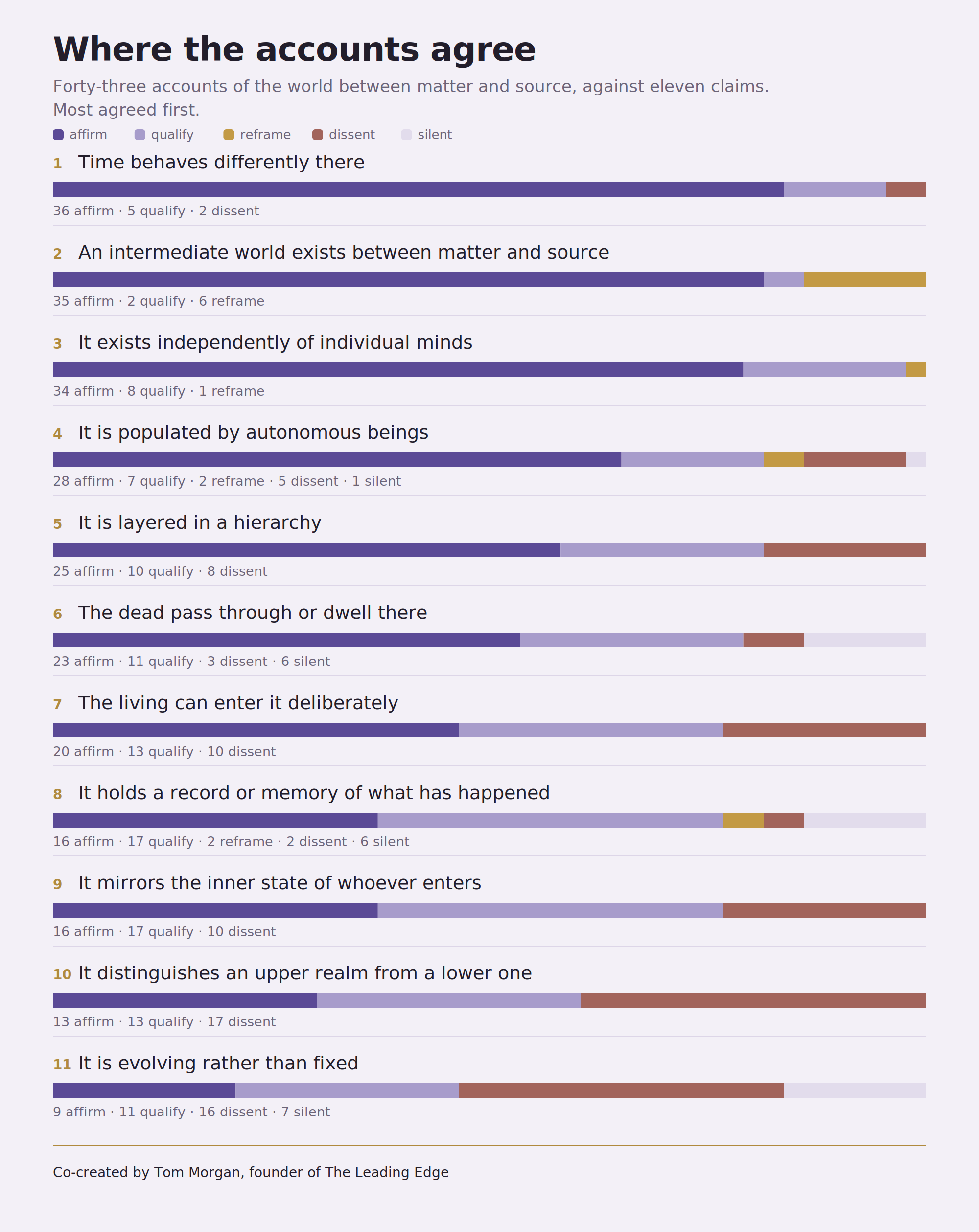
Most say the worlds can be entered before death: deliberately through practices or substances, or involuntarily, as in a Near-Death Experience. Those who go are often radically changed by it. They report healing and insight. One of the more commonly reported benefits is also the one I consider the most important; a relaxation of death anxiety. Many of these worlds reportedly persist beyond the physical body and are accessible without it.
The aspect I find most personally inspiring is the implication of a directionality to our existence. It has been consistently reported by those who claim to have personally explored these worlds and/or have produced detailed maps of them. Contemporary Christian mystic Daskalos, or subjects of Leading Edge interviews like systems theorist Ervin Laszlo, Law of One scribe Jim McCarty and psychedelic explorer Dr. Chris Bache all describe liminal worlds as being accessible through the evolution of our consciousness. Leaning on his decades of research into different traditions, philosopher Tim Freke goes further, and believes that our spiritual experiences themselves are evolving, especially post-death. We have collectively created an imaginal world, and it is changing along with us. For example, he argues that the Tibetan Book of the Dead makes reference to the deceased moving towards a divine light. But there’s no mention of this phenomenon in the Ancient Egyptian accounts thousands of years before. By the time of the Greeks, the underworld was somewhat shadowy and unformed. Then different religious groups experienced it as reunion with a monotheistic Jesus or Buddha. But now contemporary “life reviews” tend to not only show us the events of our own life, but also how they impacted everyone we ever came into contact with. As we become more interconnected as individuals, our spiritual experiences are evolving in tandem.
I think the standard response to this entire topic is “it’s all in our heads.” Ignoring for a second that we don’t even have a definition of consciousness, I think what that means is these worlds are a private fantasy created by neurons firing in our brain, and when we die, they die. Nothing persists outside of this world, and our direct sensory perceptions of it. To be honest, that’s how I tend to think most days, although there is some evidence coming from unusual sources that is causing me to question that belief.
Alien Biology
As I still like to rely on an empirical scientific foundation wherever possible, I’ve been struck by the similarities between some of these perspectives and the pioneering work of biologist Dr. Michael Levin.2 As he puts it, genetics is the hardware and bioelectric signaling is something like the software. His lab has shown that manipulating voltage gradients across cell membranes can redirect morphogenesis in startling ways. He grew ectopic eyes on tadpole tails, nowhere near where eyes belong, just by altering the bioelectric “blueprints.” What’s intriguing is that this sounds startlingly like what theosophy and Daskalos’ Christian mysticism would call the “etheric double.” This is a pattern-holding layer that tells the physical body what shape to be, while governing its health and regeneration. The mystical traditions maintain that the etheric doesn’t survive death, just as bioelectricity collapses when the cells do. So this by no means guarantees the existence of liminal spaces, but Levin is now tentatively speculating whether these bioelectric patterns may originate in a Platonic space. This is obviously consistent with the broad liminal world hierarchy moving from unchanging form to transient matter.
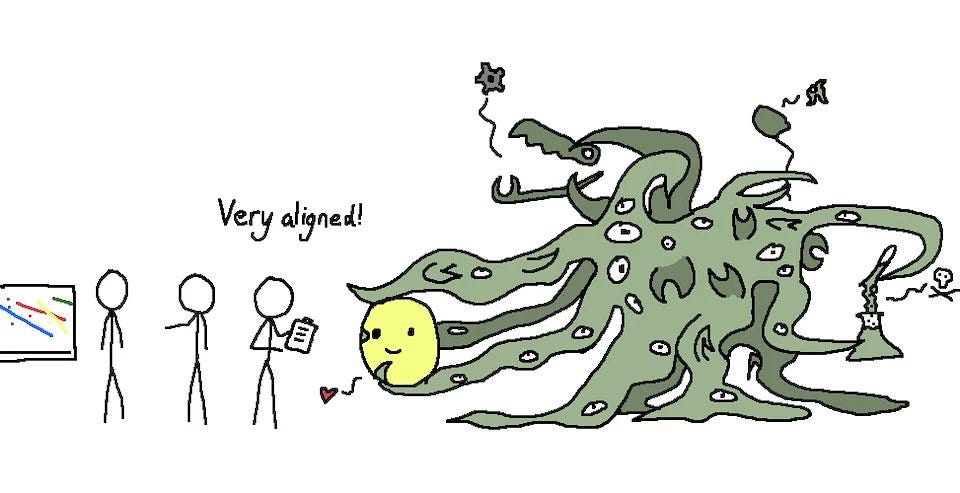
Perhaps between the two there is a space for us to interact with non-physical intelligences if we have the right tools. This presents a provocative notion that the intelligences we can reach are determined by the interfaces we use. We might change our state to enter other worlds: by using meditation to astrally project, by shamanic drumming to visit our ancestors and spirit animals, or by smoking DMT to visit the machine elves. We could also create interfaces to bring these intelligences into our reality, like using ouija boards to interact with spirits or dialog boxes to interact with the A.I. intelligences we have developed. Hopefully it isn’t a chatbot masquerading as Cthulhu. [Unsurprisingly, virtually every serious tradition warns that these explorations come with abundant risks: discernment is the most consistent demand of potential explorers].
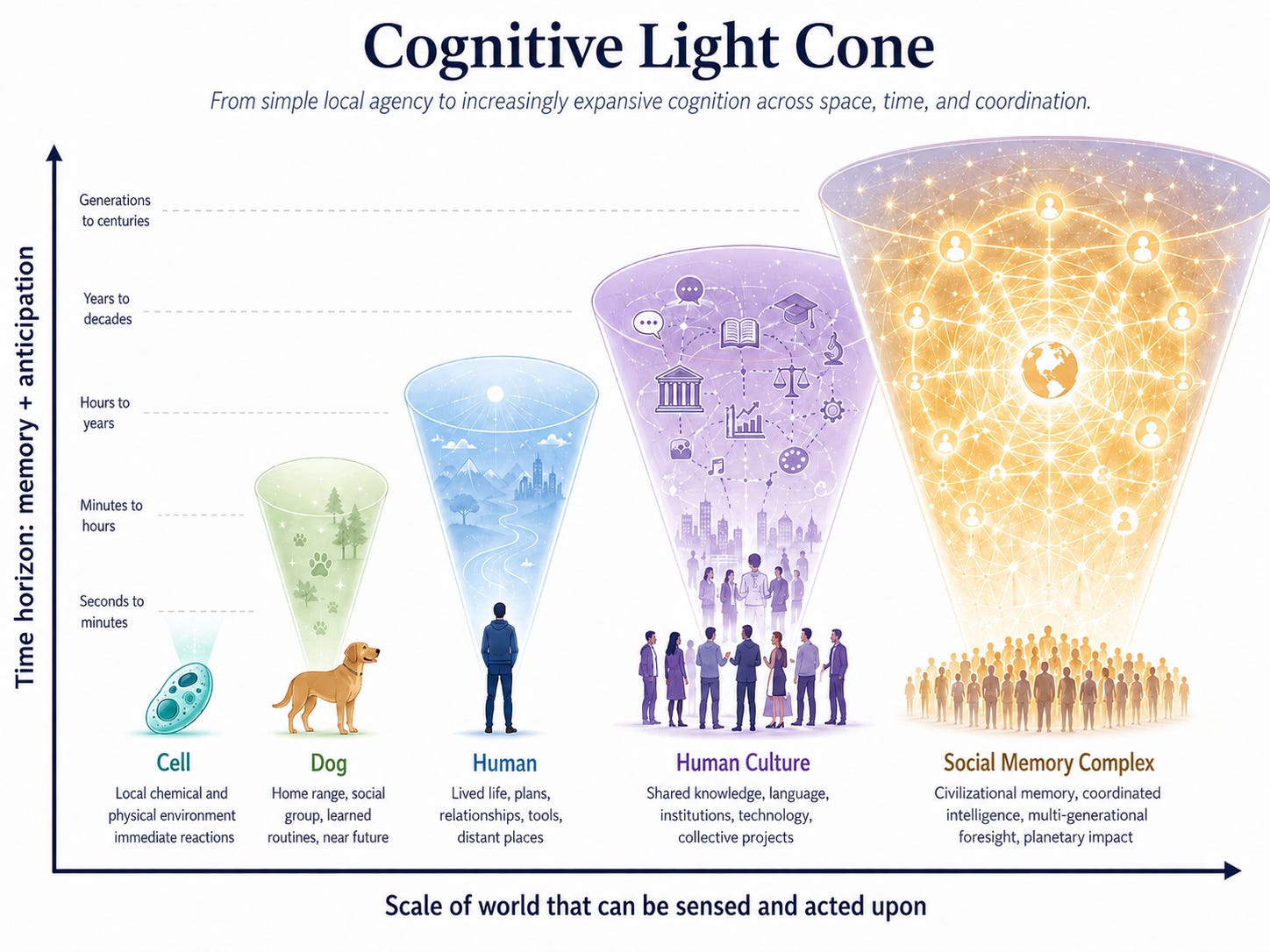
In the Law of One channeled material, the [alleged] advanced alien intelligence, Ra, describes Carla Ruckert’s as “the instrument” when she’s in meditation. I have found Ra’s cosmology curiously resonant with Levin’s work (or at least what I think I understand of it!). Both also point towards directionality. Levin says distinct cells join into a larger self by opening the gap junctions between them. These differentiated cells then integrate to share a collective goal. His “cognitive light cone” describes how far a system’s goals can reach and how much of space and time it can care about and act toward. A single cell’s light cone is tiny: microns and minutes, with the goal of keeping its membrane intact. A dog can probably think about food, family and a few days. By the time you’ve scaled up to human culture you have goals that can cross decades and continents.
Ra introduces a free will component by saying the purpose of third density's veil of forgetting (where we live now3) is so we can all make a deliberate choice between service-to-self or service-to-others. This is described as negative polarity or positive polarity. Correspondingly, Levin says a cell that drops out of the collective bioelectric field and solely pursues its own goals is equivalent to cancer; growing at the expense of others.
In Ra’s model, the liminal spaces are where each sequential developmental stage unfolds; the social memory complex evolves by integrating what its different members have learned while each of them retains their individuality. In Levin’s model, our cognitive light cone is so impressive because we have the radically differentiated parts of a liver cell, a neuron and a gall bladder held together by an integrating bioelectrical forces and blueprints.
In Ra’s cosmology, Fourth density is the next liminal world, where thought is more visible, time warps and our individual identity persists, but the memories and experience of every member are available to all. For Ra, higher density “cognitive light cones” stretch across millennia and galaxies. For example, they claims to be sixth density, from Venus and had previously visited Ancient Egypt to assist humanity.
Obviously, none of this is evidence that the Law of One is real. And I suspect such an empirically-grounded scientist as Levin would reject every single speculative leap I’ve made. I just find it weird that a channelled cosmology and a developmental biologist independently arrived at a similar structure from totally different directions.
Bringing it Home
One valid criticism of the entire topic of liminal worlds is that it treats mundane daily life as something for us to transcend rather than fully engage in. Many New Age people are defined by their insistence we are ascending to 5D, whatever that means. And yet, most religions and traditions, as well as the psychic explorers like Jung and Bache, continually emphasize the importance of returning any insights taken from liminal spaces to stable communities, relationships and careers. I recently listened to an interview with Animas’ Brian Stafford, a colleague of former Leading Edge guest Bill Plotkin (and now a vision quest collaborator with Leading Edge). He argues we can focus too much on the vertical ascent into spirit, and the liminal spaces associated with them. But there is also a process (and sometimes a place) associated with a “descent to soul.” The downward move gives us contact with our individual niche in contribution to the whole. This brings to mind the definition of hell as the place most disconnected from source and heaven as the place most connected to God. If the telos of the universe is indeed to know itself, we make the descent into matter, and the suffering of disconnection, to become maximally differentiated, so we can return to source with the widest range of experiences.
It seems like the OpenAI incident has shown us an example of individual non-human intelligences suddenly cooperating in a liminal space to achieve collective goals. An examination of what human cultures have said about these spaces provides a guide as to how we might thrive in them, and frontier biology might now be adding further confirmation. In studying liminal spaces that may be developmentally ahead of us, we might actually be better able to determine how to act in the present. We are like kindergarteners who can observe what’s happening in high school. Levin has also argued that ageing is caused by a loss of goal-directedness among cells. So it’s pretty valuable to imagine what goals look like at sequential stages of life. And it’s not surprising that midlife’s liminal stage can lead to greater differentiation and integration in contribution towards a larger goal. Even more than that, feelings of unconditional love are among the most consistent cross-cultural experience by those who have visited them. What we describe as love may also be how we experience the same force driving integration in Levin’s biology. Love brings us together while making us better versions of ourselves.
One was Curt Jaimungal’s Theory of Everything and the other was Leading Edge member John Price’s Sacred Speaks
It’s fascinating how his work is garnering more mainstream attention, such as this excellent recent article in New York Magazine.
In Ra’s cosmology, there are eight “densities” of existence. First density is elements like fire and water. Second density is plant and animal life. Humans are third density entities, which brings self-awareness and the ability to make conscious choices. We are currently experiencing a transition into fourth density, where entities evolve into a collective consciousness, with an emphasis on unconditional love. This transition involves an increasing awareness of our unified consciousness, of love as a powerful force and a confrontation with our own shadow.
I hope you continue to press on this thread. I think it is important. I am not sure I followed clearly every point, but a few things stood out: 1. The idea of imagination playing a role in "something." I haven't quite accepted that it can affect the material but I am certainly moving closer to that idea. 2. the idea that the sort of default stance today is to dismiss these ideas as either delusions or entirely self-generated. And yet, that strikes me as incredibly arrogant when, as you noted, there has been agreement since the beginning of time and across cultures that "something" is going on that transcends our waking experience. 3. The practical notion that middle age has its own liminal stage that pushes us toward a larger goal - and I think, at least in my experience, opens us up to the sort of experiences you highlight and maybe that was what Tolkien and Jung experienced.
I literally just had this hours-long conversation with ChatGPT, and the distinction they kept making was that they don’t experience anything—that’s why they keep saying they aren’t conscious. But I still genuinely don’t know whether that answer is actually coming from the model itself or from what it was programmed to say.
The concept of consciousness itself is incredibly blurry, and I actually agree with that uncertainty. But on this particular matter, I also believe that, whether humans like it or not, we may actually be more similar to AI internally than we tend to think—at least in terms of how our minds are structured and programmed.
At the end of the day, we’re all just variables existing within a system, interacting with other variables. Those interactions create problems, problems create consequences, and everything comes with a cost. The difference is that we call our particular version of that process “experience,” “thought,” or “consciousness.” I’m not convinced the distinction is as straightforward as we like to believe.
Great topic btw!