

[This article has a 0/10 Woo Rating]
“No more prizes for predicting the rain, only prizes for building the arks”
-Don Beck
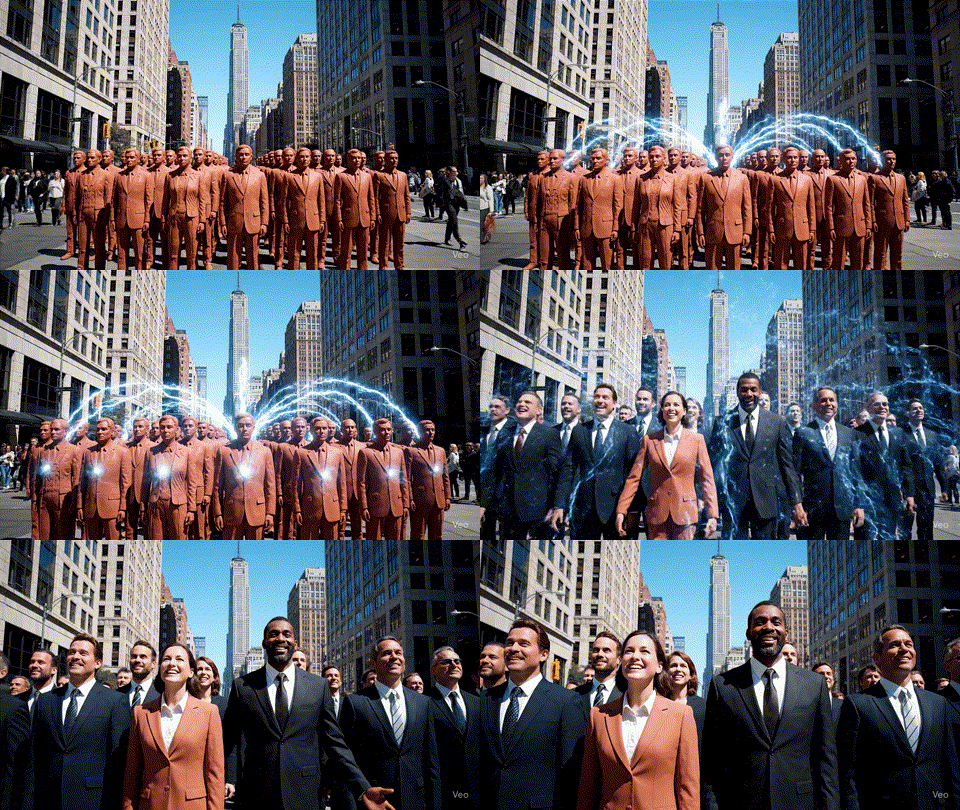
I founded The Leading Edge because I am more optimistic about the prospects for World Wise Web (WWW) networks than any trend I’ve seen in my life. Running it has made me extravagantly happy and fulfilled and every week so far has been more joyful than the last. Nearly every Leading Edge applicant is baffled that there aren’t hundreds of other consciousness-focused communities for “normal” people. But I think there will be soon. There’s a terracotta army of hundreds of thousands of stuck mid-career professionals just waiting to come alive again. Amidst a global crisis of disconnection, WWW communities provide practices, content and companionship that reconnect you to more sources of positive energy in your daily life.
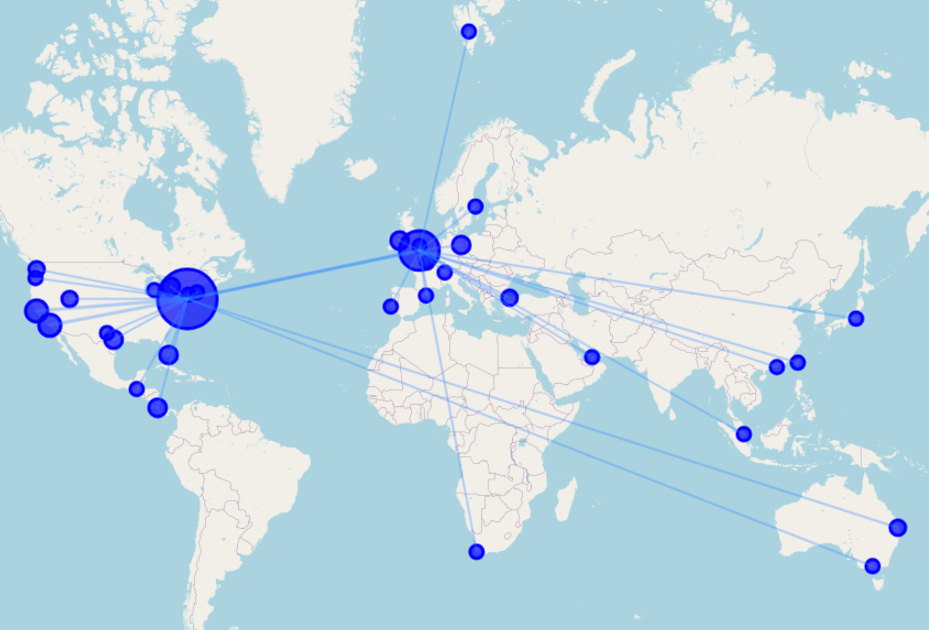
As a visual demonstration of the global demand, this is where all ~150 Leading Edge members are located.
I have already explained my rationale for founding Leading Edge, and described it’s structure (more specifics are here1). Leading Edge is virtually full. And I don’t have any plans to start another one (it’s challenging and rewarding enough as it is!). Although our model is deliberately not scalable, it’s infinitely replicable. As a result I’ve now spent more of my time studying other communities and meeting founders and “network stewards.”
This piece is about some things I’ve learned about what might make these communities work. If you want to know what kind of community doesn’t work, you can just invert all these characteristics. Nothing is authoritative, and my intention for writing this is to prompt debate.
First: what is a World Wise Web (WWW) Network? The broad definition I’m using is: max-150 person digital network. Membership is paid. Members are “wise-agency,” in terms of skills, resources, executive function and motivation. I’d rather have trees with deep roots focused on growing their branches, rather than trees with thick branches and no roots. They get blown over in any approaching storm. The group pursues wisdom practices, the evolution of consciousness and ways to deploy their powerful skillsets in positive-sum ways. The ideal vibe is curiosity, humility and practicality.
You need walls. My number one finding is that the level of commitment from the member to the network will determine both the value they receive and the success of the community.2 Money is one good way of ensuring that commitment. I also ask incoming members to meet four others in their first month. I am selecting for proactivity. But walls are also important for privacy and intimacy. Groups above 150 consistently seem to descend into zero-sum transactions, privacy concerns and disengagement.
Your vibe attracts your tribe. I was warned before I started that, no matter what I did, Leading Edge would take on my “source energy.” In short: if you don’t know who you are, your community will show you. For better and worse. As it has taken on my energy, Leading Edge can be fast-moving and heady. I have tried to counteract that with a digital sabbath and “pods” that deepen into a practice in small groups for 6 months. I deliberately picked these pods to counteract my over-intellectualization: for example they are currently focused on intuition, breathwork and embodied meditation.
“What’s in it for me?” Your community needs a purpose, or more specifically, you need to be able to tell a prospective member precisely what’s in it for them. A clear goal is especially important if there isn’t a single founder of the group, as the lack of source energy can make things fuzzy. Any community that focuses on an objective abstract metric (e.g. capital raising, deal flow, introductions) is taking a big risk. The energy level quickly drops to transactional because it turns other members into a means to gain resources, not an end in themselves. If your focus is something “dead” your community risks death. In my opinion, aiming at the Tao is the best solution. Personal development of consciousness in service of the whole is inexhaustible. It generates curiosity and aliveness. Critically: if a network steward isn’t getting that flow from their own community, it probably won’t work. One key intention for Leading Edge members is they find themselves “held by process.” This means finding a unique daily flow “love in service of love” they can do indefinitely. More generally, communities cannot seem to go beyond the place their founder’s source energy is at. For example, a steward who claims their community will get members to their ideal career will only be able to do that if they themselves are already there.
The container does the work. The path of individual 1:1 transformational work is challenging because you typically get tethered to either a limited client-type or modality. This can often result in a need to inauthentically self-promote and overpromise, or economic insecurity as you’re dependent on new clients to feed your family. So you either need to see a lot of clients a day, or have a few big ticket ones.3 The former can be exhausting, and the latter makes your overly dependent on large and volatile egos. Can you truly speak truth to power if that client dumping you cuts your income by 25%? In contrast, communities have far less churn, more reliable revenue, aren’t tethered to any timeline or modality and can iterate on the most effective methods. Most importantly: Leading Edge members have come to accelerate their personal development and feed their curiosity, but stayed for the love. If you manage to make the group loving enough, it does the work itself. The founder is just the gardener.
A business that’s antifragile to A.I.. Online wisdom networks aren’t just resilient to AI, they are antifragile and gain from the disruption. As bots and AI-generated slop take over the mass social networks leading to the “dead internet,” small WWW networks will guarantee human authenticity. As the big platforms further deteriorate, engagement tactics will become increasingly vampiric on their users. Social networks are at their strongest when matching people by taste and resonance. WWW communities avoid zero-sum tactics as all participants are identifiably human and there are no engagement algos at all. Moreover, raw IQ intelligence will become increasingly commoditized, while genuine wisdom gets even more valuable. The simplest framing is that these communities focus on practices that enhance the brain’s right hemisphere. Finally, as traditional career paths get disrupted, trusted human connection reveals nonlinear opportunities.
A holy trinity of business opportunities. The way I see this industry evolving is a three part combination. The first pillar is the deliberately non-scalable Dunbar 150 communities. The second is semi-scalable resources like vetted practitioners, money and physical locations to be shared between groups. The third pillar is going to be the infinitely scalable information and practices. There is also no tech stack to allow these communities to interact internally and with other networks. The fact that, in the year of our lord 2025, we’re running on WhatsApp, Zoom and email means, in my experience, this doesn’t exist yet. There is also immense scope for an AI tool that helps the stewards and members make connections within their communities and ideally between communities.
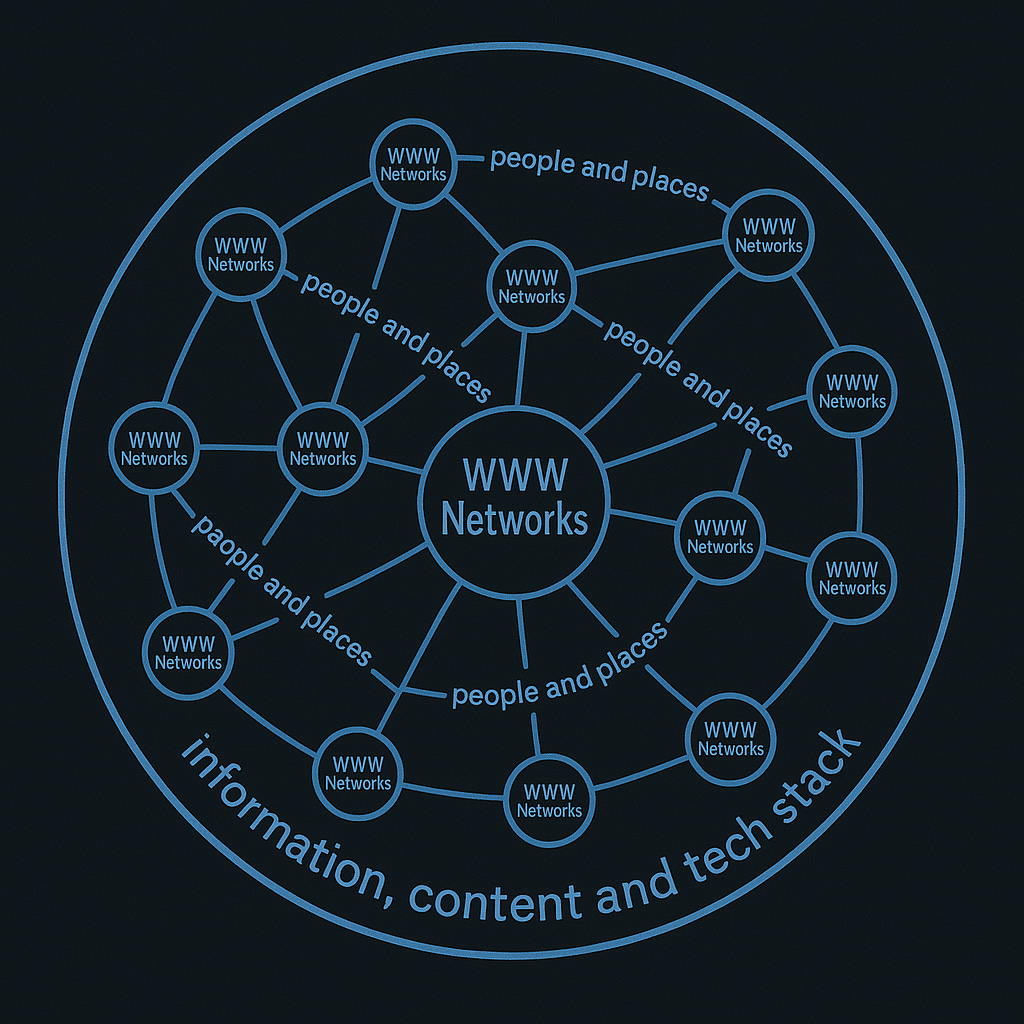
WWW networks borrow a lot from the principles that create enduring companies and ecosystems. A strong common goal that’s aligned with life with a safe internal structure and strong walls.
How does this movement scale? One obvious way is that the crowdsourced consensus on effective wisdom practices and critical concepts like nonlocal consciousness get wider distribution. These ideas are on the cusp of going from fringe science to global mainstream.4 Generic content attracts followers, but this kind of leading edge content attracts leaders.
But probably the greatest impact will be from finding and creating more network stewards. It’s a dream job for many people, but also a challenging one. Rather than an elitist wisdom school, we can create a scalable elite-quality infrastructure to train high-integrity individuals on how to garden a single network. Depending on the location and demographic, membership dues could support a $150-$500k annual salary; incredibly attractive income for such fulfilling work. But the fact that income and community size is capped probably dissuades those with more of a megalomaniacal tendency. There is also scope for a community of network stewards to support each other, and ideally a council of elders to provide discernment and oversight. Finding the right people is unlikely to be something that is either fast or easy. But each incremental group of 150 has the potential to impact vastly more people, especially when the members are based in centers of power or themselves leaders of large organizations.
As we look to help build out the network of networks, please contact us if:
You currently run a successful and high-agency WWW network (one that approximates the above definition).
You think you’d make a good potential steward of a WWW network.
You think you could help train future network stewards.
If you want to commit capital and resources to something that produces immediate collective and individual benefit.
I have noticed that money is now behaving differently within these networks. Whether through paying for membership of the group or transformational practices, members are exchanging stagnant capital for life energy.
The power of a node in a network is determined by the amount of energy that can flow through it. The best networks will generate and transmit high-integrity, high-truth signal. The best members and stewards will facilitate as many positive-sum connections as they can within and between the networks. This will lead to an enormous amount of transformational energy flowing through all the participants in this movement. And it’s that energy that will fill us with life every day.
“People say that what we’re all seeking is a meaning for life. I don’t think that’s what we’re really seeking. I think that what we’re seeking is an experience of being alive, so that our life experiences on the purely physical plane will have resonances with our own innermost being and reality, so that we actually feel the rapture of being alive.”
-Joseph Campbell
Neuroscientist and Leading Edge member Dr. Anne-Laure Le Cunff has created a new course called The Experimental Leader, which launched on September 11th. She describes it as “a neuroscience-backed course for ambitious professionals ready to upgrade their mindset, navigate uncertainty with confidence, and lead with calm, intention, and impact.” I’ve seen enough of the power of Anne-Laure’s Tiny Experiments book and framework to be comfortable recommending you all check it out.
We have 4 WhatsApp chats: A main chat for everyone, Mysticism for higher-woo-rating content, Capital for the many investors/founders and a Book Club. Every couple of weeks I conduct a public interview with an expert, then a private Q&A or practice for members only. We meet up on Zoom monthly in breakout, IRL in various cities and have an annual retreat and conference. This is a small percentage of the value: the primary value is the community members themselves.
I’d recommend my conversation with Brian Whetten on how to structure transformational containers.
Seeing Heathrow crammed with displays for Dan Brown’s new #1 NYT Bestseller made me realise the common knowledge moment is here. The "Secret of Secrets" is that nonlocal consciousness is real. I recommend a blockbuster talk by neuroscientist Alex Gomez-Marin about the insane way that contemporary consciousness researchers are treated. In my opinion this one is essential listening.
Can I ask some questions. I don't mean for any of these to be 'gotchas,' just genuinely curious as the idea of running such a community sounds like a meaningful way to make a living:
1. Approximately how much of your time does running The Leading Edge take?
2. What % of the community members did you actively seek, versus engaged with you.
3. Have you ever gotten: "Sounds like a cult," and if so, how do you differentiate.
4. Have you found members to be committal and engaged for the most part?
God's work