

The Creative Illness
“In many societies, illness is understood as a call, a sign, a special sensitivity of the spirit that can be useful in regulating group behavior. Like the canaries miners in Appalachia carry into the coal mines to warn them of toxic fumes, the schizophrenic or neurasthenic may be one of the first to react to dehumanizing environments.”
-Helene Shulman, Living at the Edge of Chaos
Every year, I meet with hundreds of people to explore finding the most meaningful path in their lives. About eighty percent of the time, they are consumed by one core fear. This is the belief that making the wrong choices will leave them (and their family) alone, broke, and fundamentally unsafe. They are constrained by the harsh realities of rampant inflation, health insurance, and college tuition. Leaving a stable paycheck, however stale it has become, can feel like a mortal risk. The sense that we are not held prevents us from living the lives we want and from creating the world we want to inhabit. Money, specifically the fear of losing it, is overwhelmingly the biggest blockage on our path to purpose. This fear has infected our society down to its bones.
Wetiko is a Native American word for an insatiable cannibalistic spirit or sickness, it consumes the life force of others for its own gain.1 It’s the energy that says we can never have enough in order to feel genuinely safe. In other cultures, the shaman would observe the disease that afflicted the village. They would then contract it. Sometimes it would kill them. Sometimes they would heal themselves and, in doing so, would gain the ability to cure it in others. These shamanic calls are as old as humanity, and they haven’t gone away just because we stopped talking about them. We’ve just pathologized them instead. For many years, I’ve been gripped by the definition of what Canadian psychiatrist Henri Ellenberger described as a “creative illness”:
A creative illness succeeds a period of intense preoccupation with an idea and search for a certain truth. It is a polymorphous condition that can take the shape of depression, neurosis, psychomatic ailments, or even psychosis. Whatever the symptoms, they are felt as painful, if not agonizing by the subject, with alternating periods of alleviation and worsening. Throughout the illness the subject never loses the thread of his dominating preoccupation. It is often compatible with normal, professional activity and family life. But even if he keeps to his social activities, he is almost entirely absorbed with himself. He suffers from feelings of utter isolation, even when he has a mentor who guides him through the ordeal (like the shaman apprentice with his master). The termination is often rapid and marked by a phase of exhilaration. The subject emerges from his ordeal with a permanent transformation in his personality and the conviction that he has discovered a great truth or a new spiritual world.
I recently appeared on two podcasts with my friends John Price on The Sacred Speaks and Devin Martin on Personal Kosmology. Our conversations really made me reflect on the hellish three years of my life between 2017 and 2020. I don’t want my current flourishing to be constantly defined by long-past trauma, but Ellenberger’s creative illness describes my lived experience precisely. I initially found myself at a desk surrounded by people too stuck and afraid to leave lives that had become dead. I made a heartfelt desire to help them, and myself. During the florid insanities of the psychosis that followed, I felt like I encountered something like the Wetiko mind virus.2 It wasn’t just within the depths of my being, it was within the catacombs of Wall Street itself. These encounters were moments of open-mouthed horror. The years that followed saw a pitiful and agonizing series of failed life transitions. I felt infected by an all-consuming loss of safety. My nervous system was absolutely shot. I constantly felt like I was about to run out of money. And when my net worth read zero, so would my self-worth. The passage of time itself became incredibly hostile.
Like a drowning man clutching at tiny pieces of driftwood, I desperately lunged at careers and ideologies that I felt would make me feel safe again. Maybe it would be Catholicism, or Buddhism, or coaching, or hospice work. In retrospect, they were all utterly inappropriate and so crumbled in my hands as I fell deeper into the depths. All throughout that time, as in Ellenberger’s creative illness, I maintained the most superficial of outward appearances. Yet I moved through the world like an actor playing a version of myself, totally absent of spontaneity and so obsessed with finding an escape route that I could barely speak. Virtually every second of every day was dominated by a single looping preoccupation: how we can we find meaningful, safe, paths in our lives?
As in the case of a creative illness, I also emerged with a permanent change in my personality. I also now understand what the cure to our culture’s collective disease might be.
Unclenching and the Cure of Curiosity
There are some ideas that change your entire life in an instant. I’ve often talked about what this idea was for me, and I even remember exactly where I was when I heard it. In late 2017, I was standing in the security line at Newark airport, listening to a podcast by another Canadian psychiatrist, Jordan Peterson. He was giving a lecture on the biblical story of Jacob’s Ladder and the nature of shamanic initiations. Despite Peterson’s increasingly problematic career and trajectory, I have to admit it’s still one of the best lectures I've ever heard. The precise moment that electrified me was when he said that Carl Jung believed that your future self directed you by controlling your interests in the present. Peterson described it as a mind-boggling idea. It has certainly changed my life. I now believe that our curiosity can be a relationship with a benign force that evolves us and guides us out of periods of stuckness. When I started sharing these ideas with my sickly tribe stuck in finance, the universe immediately set me back on the right track in my life. I was hired, virtually out of nowhere, by a forward-thinking wealth manager. I wrote about these ideas that brought me alive, and specifically for the group that would be least likely to be exposed to them.
In the last few months, I have also come to wonder if there is a physiological aspect to all this. Jonny Miller’s superb recent essay “How to Unclench” received nearly 2 million views on social media. After the better part of a decade teaching nervous system mastery, he believes the key is the ability to unclench. Jonny and I have both been fascinated by “latch theory;” that our muscle fibers can lock certain parts of the body into contraction during periods of trauma. We then lose access to blood flow and intelligent input from that part of our body. These latches can persist long after the triggers themselves, waiting for an emotional all-clear signal that may never come. When we finally unclench, we release tension in our body in a way that allows us to feel and respond to the world in a broader range of ways.
I think there’s a speculative connection here with the work of pioneering biologist Dr. Michael Levin. As Levin puts it, genetics is the hardware and bioelectric signaling is something like the software. Our bodies seem to grow toward a kind of target shape, a master blueprint they keep returning to even when disrupted. His most recent paper so gripped the popular imagination that it attracted over 1.5 million views on X. In it, Levin asks whether that target pattern might exist in a “Platonic space” of some kind. In a fascinating parallel, Jung also believed your future Self that called to you through curiosity existed outside of time in some way.
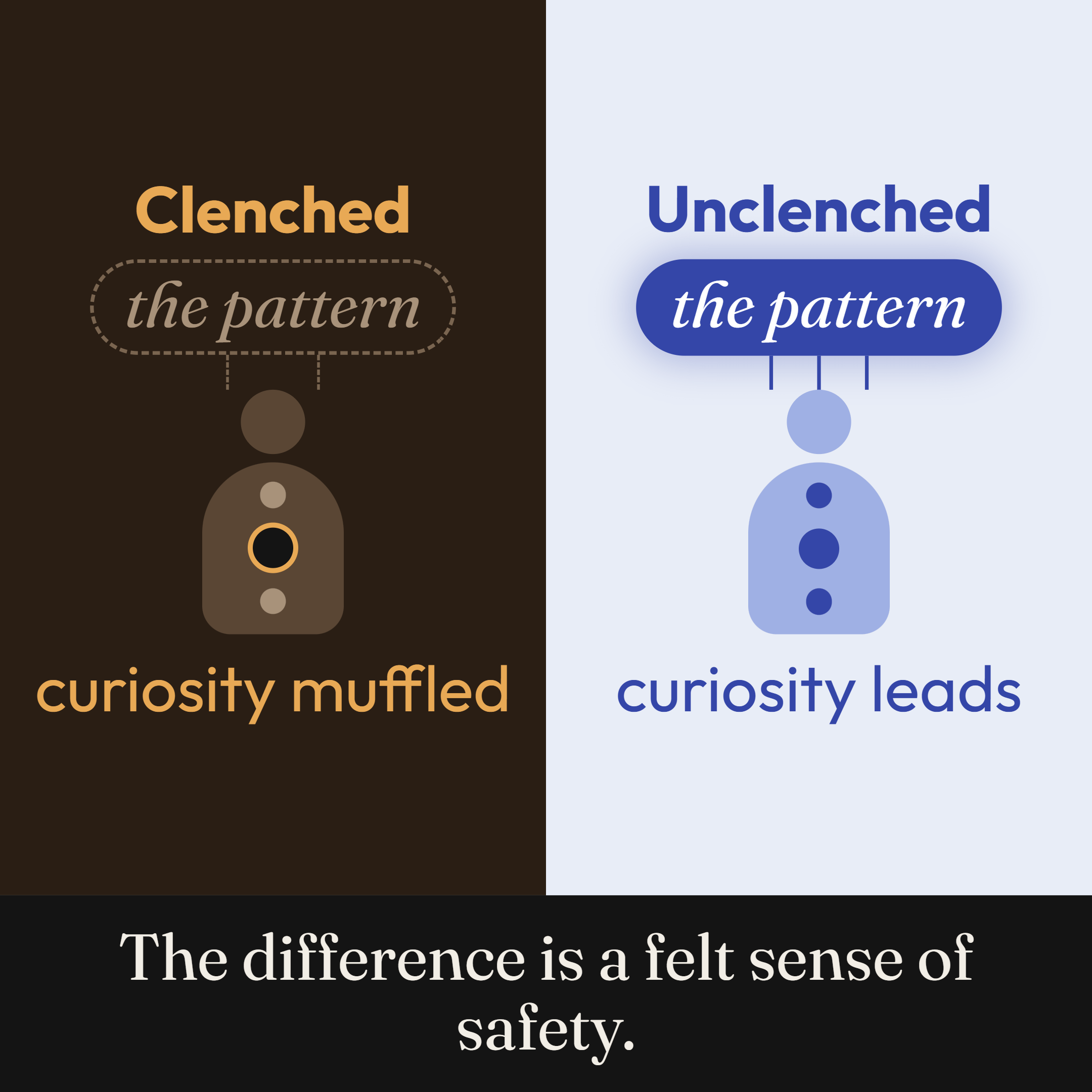
Resonant with long-standing traditions like Chinese medicine, Levin proposes that different parts of the body may be intelligent in their own ways. In Peterson’s lecture, he also discusses a perspective, consistent with Internal Family Systems, that our psyche is made up of a group of intelligences. By aligning them around the transcendent, we can pull ourselves together as people.3
Siberian shaman would experience a visionary state where evil spirits cut off their heads, so that they could watch themselves being fully dismembered, down to the skeleton. They would be shut alone in a house alone for three years and then ultimately reassembled with the ability to heal. Ailments were associated with different body parts and each disease-spirit eats the one that “belongs” to it. Afterwards, the shaman could cure the illnesses caused by exactly those spirits that each took a share. For the Native Americans, Wetiko was believed to infect our hearts. On the night of my initial descent to hell I had a waking vision of a snake filling my heart with poison. Anatomically, our hearts are electrical transmitters and receivers. In losing access to them perhaps we block our draw towards the broader blueprint. After all, what is curiosity but feeling and following our hearts? And when our parts are similarly reintegrated around a holistic guiding force, we can learn how to heal ourselves and others. In my lived experience, contact with this force can certainly make us feel safer; more held.
If it’s so beneficial to our evolution, surely we need to experience this bioelectric pull somehow. What if it’s through what electrifies and excites us? But if each part of us has its own intelligence and is meant to stay in relationship with the larger pattern we’re growing toward, then clenching, whether temporarily or for years, may disconnect parts of our body from that process. And that could interrupt our path toward our fullest unfolding. It also makes me wonder if there are not just psychological parts, but literal physical locations of our bodies that are still feeling unsafe, despite the triggering trauma having passed years ago.
Once I found a way to fill my days with curiosity, my money concerns and comparisons have mostly evaporated. I write, roll jujitsu, meet people, and steward the Leading Edge network. Financially, I don’t make a lot, but I feel like I make enough. As I discussed with Devin, the most heretical suspicion I have, the one I find can trigger the most people, is that our freedom may not be directly correlated with economic privilege. What if, when we find the right niche, the intelligence that shapes our reality can even integrate the ravenous Wetiko, the disease spirit of late-stage capitalism. When we bring our authentic selves into contribution with the whole, we will be held. In the last few years since my recovery, I’ve repeatedly had money appear from entirely unexpected sources at precisely the time I needed it. And maybe learning that lesson is the reason why many of us are here in the first place.
Where are all the Shamans?
Whether or not these mystical ideas or cutting edge theories prove to be literally true, it’s beyond doubt that a felt sense of threat constrains your curiosity. I’ve spent several years joining and studying different communities and teachers. I am convinced that the right community structure can be a major contributor to feeling held spiritually and economically. And yet one of my greatest disappointments so far is that more communities aren’t being stewarded by the people with the capacity to lead them. Put simply, their leaders are mostly spiritually adolescent men. Men who haven’t been initiated. Too many modern “shamans” have just swapped the suit for the Burning Man robes and changed their name from Douglas Smith to Angel Riverheart. And I honestly don’t blame them. A quick outer transformation is a lot more fun than slow inner dismemberment. But that speedrun means they’ve skipped being cured of that underlying sense of scarcity. This is a fatal flaw for any aspiring leaders and spiritual teachers. Especially in communities, it leads to a grasping transactionality at the foundation, so nobody feels fundamentally safe.
Whilst this is obviously a backhanded compliment to myself, and the community that we’ve built, it’s one I think I’ve earned through three years in Hell and now another three years of feedback from our members. And while I’ve become increasingly good at “doing” when it comes to following my curiosity, I remain laughably poor when it comes to “being;” content in the absence of that stimulation. But I’ve been working on it. My recent experience with bodywork has shown me places I was comically clenched, well below my level of conscious awareness. As you would expect, Jonny’s article is a treasure chest of practical tips to help you unclench. Months of Egoscue physical therapy has allowed me to identify and slowly address chronic clenching in my lower back. (One amusing detail is that the root cause appears to be instability in my right hip socket, exactly the same place that Jacob dislocated wrestling with an angel). Most reluctantly, I’ve restarted meditating after nearly a decade. Devin has helped me understand the benefit of meditation as raising the volume on life’s more mundane experiences. I’m hoping it means that I can find a greater sense of baseline pleasure and reduce the draw to distractions. You can’t follow your bliss if you can’t feel your bliss.
Shamanic dismemberment, unclenching, bioelectricity and IFS all align around the same theme of returning dissociated parts to the whole. Scarcity energy, and the associated money pathologies, represent our village’s disease. It has corrupted many of us, and our institutions, down to the marrow. But I believe money, like that clenched part of ourselves, wants to be reintegrated. When every part of us, physical or psychological, is aligned around what excites us, we might cure that sickness in ourselves.
Paul Levy explains his understanding of Wetiko here. He also writes about how Wetiko’s power comes from the fact that it is unseen. “The crucial insight: the moment we recognize wetiko, it begins to lose power. The cure isn’t waging war on evil or waiting for others to wake up; it starts by noticing how our attention and reactions feed the very patterns we oppose—and then withdrawing that food.”
For me, the archetype came in the form of Moloch, the Canaanite god of child sacrifice. The concept was made famous by Scott Alexander in his terrifying and seminal essay called “Meditations on Moloch.” Moloch, like the Wetiko, is the force that drives zero-sum games, that can only be won at the expense of others.
In our usual timely way fellow Leading Edge member Justin Wilford, PhD just wrote about IFS as a path to this kind of magic. “Liberation in IFS requires unblending from parts and unburdening them so that they can live out their true nature with divine freedom. It never ceases to amaze me that when parts are finally unburdened and we ask them what they truly want to be doing, their answers are always directed toward love and wholeness. Their true freedom is always already divine.” I also conducted a great interview with Leading Edge member Nadja Taranczewski on her work around money and IFS.