

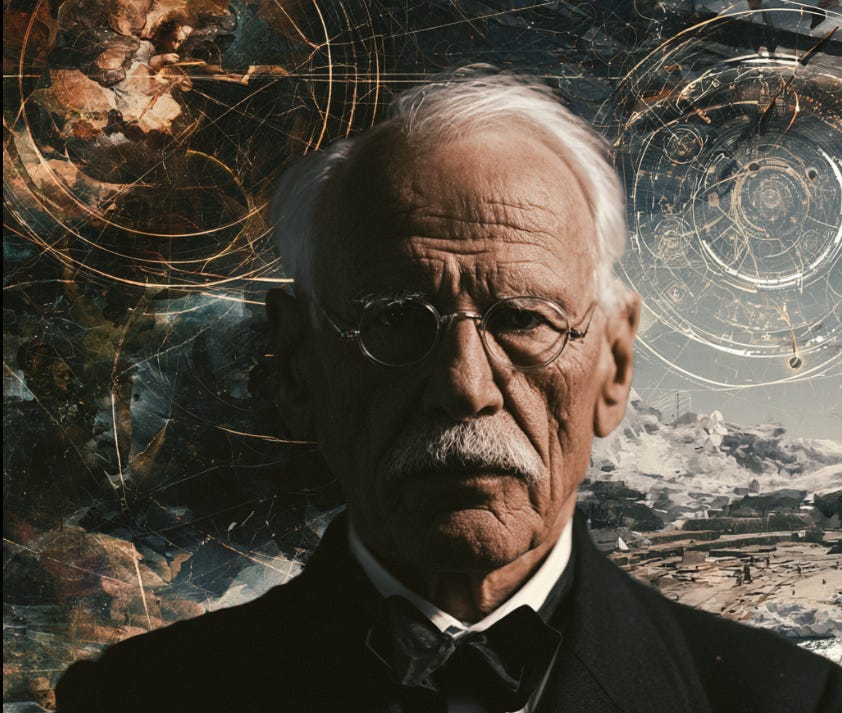
“There is much evidence on several levels that there are at least two major tasks to human life. The first task is to build a strong “container” or identity; the second is to find the contents that the container was meant to hold.”
-Richard Rohr
In the last two and a half years, Leading Edge members have exchanged more than 25,000 messages in our WhatsApp groups. Our community of founders, investors and mystics have been sharing what has been most meaningful and helpful in their own evolutionary journeys. Carl Jung is by far the most frequently mentioned influence, 50% more than his next closest competitor in second place; Dr. Iain McGilchrist.
Why Jung?
Here is my basic understanding of Jung’s worldview. You are not solely your conscious ego; something larger, older and smarter is already running the show. And it’s driving you towards wholeness rather than comfort. Jung called this greater intelligence the Self: the organizing totality of the psyche, within which our ego is only a small part. It pulls you back into balance, whether or not you consent. It can only be seen indirectly, through the symbols it brings into your life: dreams, neuroses, passions, synchronicities and the people who fascinate or repel you. The work is not to constantly interpret these into certainty, but to stay in relationship with them; to maintain the tension when the unconscious contradicts you. This alchemy can produce a third thing that neither side could have produced alone. That necessarily means integrating what you'd rather disown, because wholeness must include our darker half. In the book Balancing Heaven and Earth, Robert Johnson summarizes this perspective beautifully:
When Dr. Jung was once asked what the meaning of a human life was, he replied that it was to relocate the center of gravity of the personality from the ego to the Self, another way of saying what the apostle Paul once observed: “I must decrease that He may increase.”
Jung believed the first half of life was about establishing a solid ego structure, and the second half was about individuating into alignment with the self. It may seem odd that many conventionally successful leaders would consistently be drawn to a philosophy that makes the decentering of their powerful ego structure such a big focus. But Jung’s work provides the dignity of an explanation for why an outwardly successful life collapses in a way modern society has little tolerance for. A period of intense psychological difficulty in midlife is therefore neither a shameful crisis nor a mental health “episode” to be managed, but a necessary unfolding of your personal evolution. If you asked me to select a single (long) paragraph that reflects my personal experience of this process it would be from Jung’s student and collaborator Marie-Louise von Franz:
“Jung has said that to be in a situation where there is no way out, or to be in a conflict where there is no solution, is the classical beginning of the process of individuation. It is meant to be a situation without solution: the unconscious wants the hopeless conflict in order to put ego-consciousness up against the wall, so that the man has to realise that whatever he does is wrong, whichever way he decides will be wrong. This is meant to knock out the superiority of the ego, which always acts from the illusion that it has the responsibility of decision. Naturally, if a man says, “Oh well, then I shall just let everything go and make no decision, but just protract and wriggle out of [it],” the whole thing is equally wrong, for then naturally nothing happens. But if he is ethical enough to suffer to the core of his personality, then generally because of the insolubility of the conscious situation, the Self manifests. In religious language you could say that the situation without issue is meant to force the man to rely on an act of God.”
What might help us remain in relationship with our inner lives during periods of change? Is there a constructive role for technology here?
A series of synchronicities led me to connect with Mollie Adler, host of the popular Back From the Borderline podcast. She told Leading Edge her story and showed us MOODS, an innovative AI tool built to help people work with their inner lives through reflection, symbolism and self-inquiry.
As her episode Emotional Alchemy unflinchingly describes, like many others, she was also drawn to Jung during one of these periods of agonizing stuckness. For as long as she could remember, she had been asked to adopt multiple unrealistic identities that weren’t her own: be a girlboss, be sexier, work harder, be easier to love, explain yourself better, be less intense. She ended up on six different psychiatric medications. At her wits’ end with the traditional mental healthcare paradigm, she found herself walking into a metaphysical shop in LA and instinctively bought her first tarot deck. Reflecting later, she realised she loved the fact that the cards didn’t ask her to explain herself in any kind of literal language. Symbolism gave her another way into her own experience.
Valentin Tomberg’s Meditations on the Tarot is another one of Leading Edge’s most influential books. Before I encountered any of this work, my mental image of tarot was of a dodgy woman in a tattered shawl beckoning you into a dusty room and reading your future. There’s an alternative framing that’s more nuanced than that. Tomberg and Mollie both stress that it’s about reflecting on a symbol and allowing it to change you. Tomberg says that the ideal way to contemplate the tarot is “concentration without effort,” a phrase that Mollie says has been seared into her mind. This helps explain her draw to Jung, which is also strikingly similar to the reasons I sought from within Leading Edge, including three of our “full-time” Jungians in the community. Put very simply, Jung’s work prompts us to remain open. In order to allow us to be transformed by hidden forces larger than the ego, we need to learn to see the world in symbolic terms. Mollie and her partner Zaz have developed a tool designed to help people work with their own inner material without handing over final judgment to an external authority.
“Open” A.I.
“Suppose an age when the machine gets on top of us …. After a while, when we have invested all our energy in rational forms, they will strangle us…They are the dragons now, they became a sort of nightmare.”
-Carl Jung, after visiting New York
My favourite book about Jung is Peter Kingsley’s Catafalque. Although his message is pretty miserable at times, Kingsley makes the compelling case that Jung was actually a prophet. Through his own mystical explorations he foresaw a dark future for humanity, yet had to conceal his sources in scientific and psychoanalytic language lest he be dismissed as a raving lunatic. He returned with the diagnosis that our rational intellect was destroying the world. But, unlike so many reductive doom-mongers, Jung also had a constructive prescription, in the form of individuation. Our technology can either work with or against this drive towards wholeness.
A.I. carries the obvious risk of doing our thinking for us, as well as the slightly more subtle danger of prematurely curtailing our explorations. When Jung asks us to sit in the tension of opposing forces, A.I. can close your loops and tell you the answer immediately, irrespective of if it’s true to you.
What would technology that helps us “remains open” look like?
In direct opposition to the dominant models, Mollie and Zaz have created the browser app MOODS. They describe it as “a private system for working with your inner world without performance or an audience.” It offers a private place to explore dreams, reflect on what is happening in your inner life, or work contemplatively with tarot.
Like many people, I am inherently suspicious of using A.I. in the context of mental health. Mollie is careful not to present MOODS as therapy or a mental-health treatment; she sees it as a private tool for self-inquiry and working with the inner life. She has also written a nuanced take on the topic where she explains her desire to engage with new technology constructively, subject to specific constraints. I am regularly pitched A.I. self analysis tools that I have found indistinguishable from Claude or ChatGPT. But, so far, MOODS seems different. It’s also rare that something makes it into my daily rotation in a consistent way. But I have been working with MOODS for many weeks now. Whenever I can remember a dream in the morning I often explore it with the app. As a result, their vividness and symbolism has exploded, as has my ability to recall them. For the first time in my life, I have now had the same dream eleven times over a period of just a few weeks.
MOODS also helps me retain relevant little details that would usually be washed away with the first waking wave. For example, I recently dreamed of an uncanny energy emerging from my bedside table, and a poker chip came sliding out and zigzagged unnaturally across the floor. As strange as it sounds, I would have ignored the poker chip until MOODS asked about it specifically. After sitting with it for a while, I suspect that dream was about my own uncanny intuitive senses “escaping” from my most private space (my bedside table). The poker chip may reflect the sense of chance and unpredictability that come with these abilities.
I have been using MOODS’ dreams tool for the exploration of nighttime symbolism and the tarot for recurring patterns in my waking life. I understand that MOODS may not be for everyone. It does offer its own directional interpretations and reflections, including ones you may not have reached alone, while leaving the final judgment with you. MOODS didn’t tell me what the poker chip meant, but it brought it to my attention. I appreciate the criticism that MOODS could close down these processes prematurely. If that’s the case, our own Jungian wizard Dan Lawrence recorded a stunning lecture on working with your dreams. “Active imagination” is another one of Jung’s preferred practices. From what I understand, this is about treating the imagery that arises in your mind as potentially autonomously intelligent and interacting with it as such. For his part, Kingsley focuses on incubation, lying in stillness and darkness, as a revelatory technology. A unifying feature seems to be the diminishment or removal of the exterior senses so that the symbolic messages coming from (or through) your bodily unconscious can be received more clearly.
Ultimately, I think the members of Leading Edge are drawn to Jung for the same reasons they are drawn to Dr. Iain McGilchrist. Both have provided robust explanatory models of the world based on science. Both warn about the personal and civilizational risks of excessive rationality. Both describe larger forces that guide and evolve us. And both provide practical guidance as to how to connect with them. Too much of today’s tiresome artificial intelligence discourse overwhelmingly focuses on the ways that our left hemispheres will get commoditized. This is why I spent more than a year exploring 11 tools and practices to become more right-hemispheric, and Jung’s work was highly influential. Maybe platforms like Mollie’s will show us a path to integrate these technologies rather than be devoured by them. For me personally, there has been a single unifying message that has emerged from Jung’s work. As I wrote in my recent piece on “Earth School,” whatever mechanism you choose, learning to see the world symbolically helps you navigate life’s lessons, and perhaps the pain of individuation, with less friction.
What surprises me about the people who glorify Carl Jung is that they rarely seem curious about the human being behind the myth, the one who coined the term individuation (the process of becoming psychologically whole) while quietly splitting his life into compartments so that no single person would ever see the full picture.
Emma (wife) for social legitimacy, Toni Wolff (decades-long mistress) for intellectual stimulation, and his study as a refuge from the children he couldn't stand to be around.
He was an emotionally absent and authoritarian father, and started intimate relationships with his patients.
Don't get me wrong, his work is remarkable, but Jung himself understood the shadow better than he ever lived it, and understanding it is so much easier and more satisfying than the far messier project of actually living differently because of it.
This matches what I have seen with shamans, coaches, therapists, and gurus in my spiritual journey over the last decade.
Often, they fail to embody what they preach.
I’d rather look at what a person does when nobody is looking.
- How are they as father/mother?
- How are they as husband/wife?
- How do they treat their friends?
- How do they show up with strangers?
This is the only work that matters after all.
“those who preach god, need god
those who preach peace do not have peace
those who preach peace do not have love
beware of the preachers” - Charles Bukowski
I dream infrequently yet when I do, the messages have a profound energy that is difficult to materially place. This week, a dream was too vibrant to simply shrug off. I immediately recorded a voice memo, and days later, I added the transcript to MOODS along with recent tarot pulls. MOODS delivered an incredible interpretation of the dream’s details - or my memory of them - coupled with current relational dynamics brought forth in tarot. To say the app’s feedback was insightful is an understatement. While careful not to assign certainty to my next move or imply how I should register emotionally, MOODS gave me language to convey in conversations with those who’re in my psyche.