

“The best “mechanism” imaginable for adapting to change would be one that sensed or saw what is to come—the future—which would enable transformation to begin before the coming change had arrived in full force.”
- Ingo Swann

There’s an energetic charge which comes with encountering something that is at the very frontier of what’s emerging next. For me, this “future sense” is an inexplicable curiosity towards an idea or person that I know is going to change me. Future Sense draws us toward the edges of our own development, often before we can rationally explain why. Some people can feel where the world is headed, and they will be far more adaptable than their peers. As everything around us accelerates, nurturing this ability may be among the most important things we can do. So is finding the others who have it.
If I’m being honest, I think that I’m pretty good at anticipating future trends. It’s why I called our community Leading Edge. As early as 2015, I was writing about artificial intelligence, self-driving cars, drones, and exponential business models. Over the last few years, I feel I’ve been able to correctly detect the early emergence of certain themes into the zeitgeist. Whether it’s psychedelics, psychic phenomena, or an interest in consciousness in general, I’ve largely been ahead of the game. I think Leading Edge is going to be ahead of the game again when it comes to the popularity and formation of our new kind of community and the Network of Networks that will connect them.
In fact, I believe these communities will allow their members to increasingly predict and build the future.
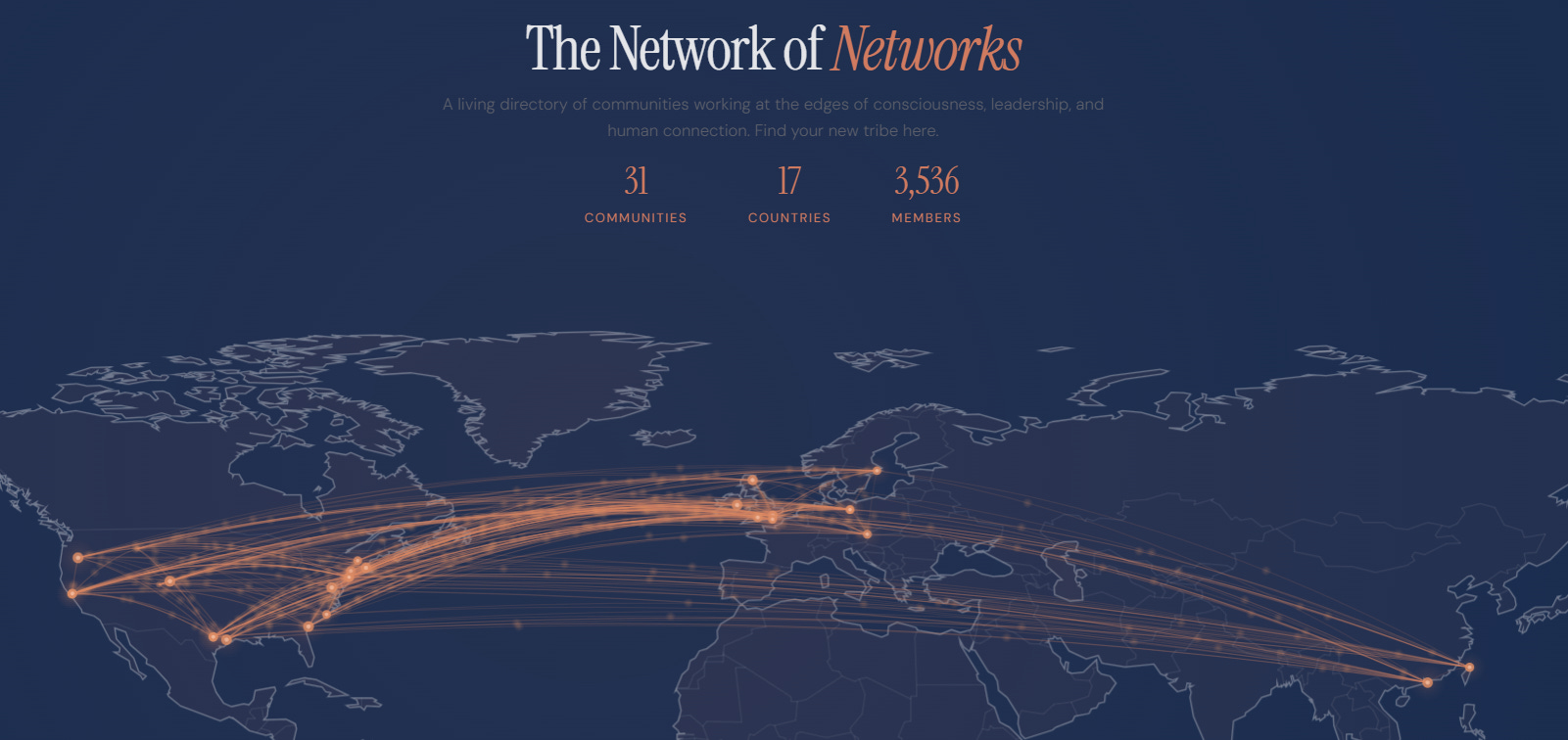
As I expect you know by now, I believe the most effective way to create the conditions for a cultural phase shift is through private communities of ~150 people. The ideal members will have a strong “future sense” in terms of their hunger to explore new frontiers and new relationships.
Obviously thousands of online/offline communities already exist, but they tend to cluster at either end of an unappealing spectrum, from powerful, but nakedly transactional, to spiritually curious, but ineffective. The sudden emergence of a new breed of modern professional, disaffected by the traditional system and galvanized by the emergence of AI, has presented explosive demand for a middle way.
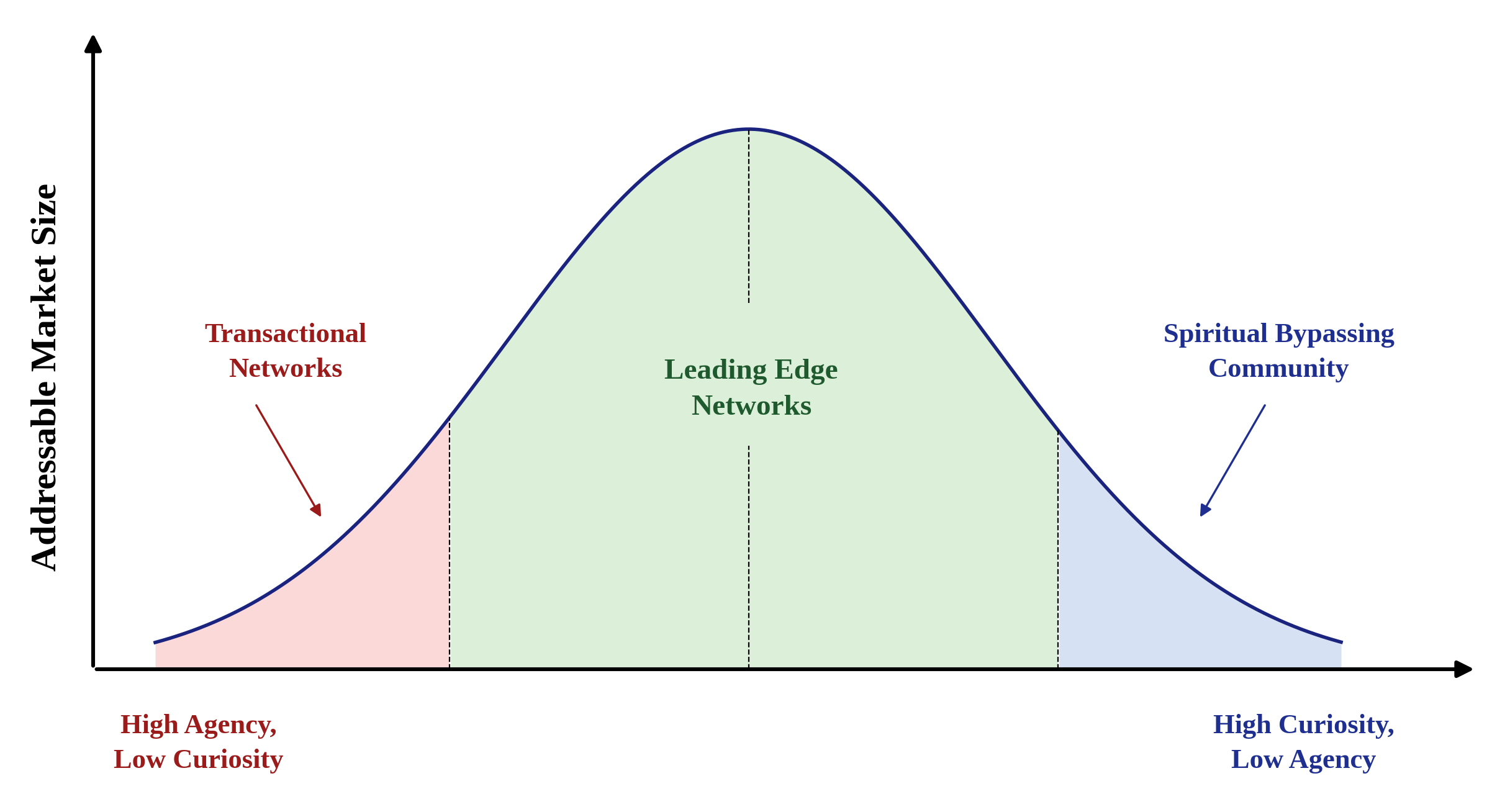
The most uniform characteristic of all Leading Edge members is a powerful combination of agency and curiosity. This drives them to explore the frontier of what’s emerging, and to create businesses, charities, and careers in alignment with it. In my last five years of studying and joining communities, I believe this combination is new, and accelerating.
It’s pretty obvious that if you’re around other curious people, you’ll be exposed to even more transformational ideas and practices. There are times it has felt like Leading Edge is operating like a collective intelligence, detecting important themes well before they enter the zeitgeist. We were years ahead of the now-mainstream popularity of pioneering biologist Dr. Michael Levin. We understood the paradigm shifting potential of near-death experiences long before Dan Brown’s book Secrets of Secrets rocketed to number one on the New York Times bestseller list. We were debating The Telepathy Tapes months before it became the most popular podcast in America. This collective foresight has enabled many of our members to make prescient high-integrity investments or found positive-sum start-ups.
Nevertheless, some of these mystical topics still remain socially taboo. For high-performers, interest in spirituality can be perceived as a loss of discernment or competitive edge. Moreover, without support, even popular psychotechnologies like meditation and breathwork can also be surprisingly dangerous. This is one good reason why these groups need to be intimate and private. But there’s another, even more important one.
Show Yourself
I always thought the primary draw of Leading Edge would be personal transformation. I was wrong. It was actually for people that felt that they couldn’t show their emerging selves in their professions, their partnerships or their peer groups. That creates “epistemic loneliness,” an unmet desire for meaningful connection exacerbated by being unable to share how you now see the world with the people around you.
The people most sensitive to new emerging possibilities often cannot safely express them inside their existing professional and social environments. What people can’t show at work or at home is the part of them that’s already oriented toward what’s coming next. And it needs a cocoon to grow. I regularly think of futurist Kevin Kelly’s advice: “try to work on an area where there’s no words for what it is that you do… When you are ahead of language, that means you are in a spot where it is more likely you are working on things that only you can do. It also means you won’t have much competition.” You probably won’t find those fresh paths advertised on LinkedIn. I’m not even sure my mum understands what I do. These communities are playgrounds to experiment with emerging identities, careers and intuitive gifts.
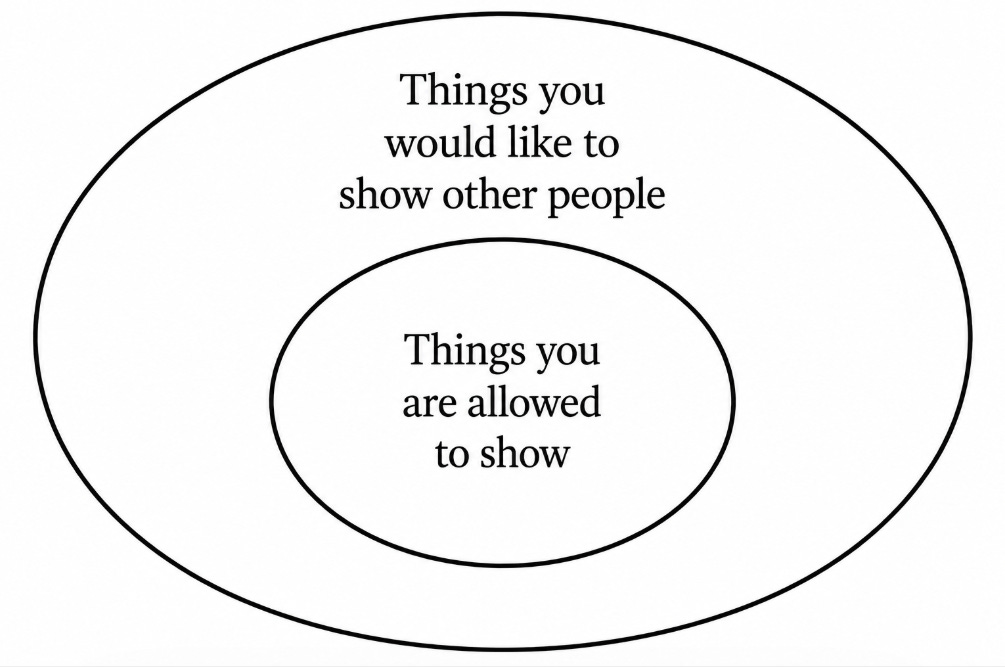
The moment our members could show their full selves and drop the professional persona, close relationships have followed very quickly. Curiosity drew us together, and now it has created authentic, trusting relationships. This is also why I believe these groups should be capped around 150 people. Robin Dunbar’s research suggests there are cognitive limits to the number of stable social relationships we can maintain, with roughly 150 often appearing as an important upper layer. My own experience of communities that grow too quickly has repeatedly reinforced that intuition. Forming and maintaining relationships takes time and effort.
Close relationships have been the prerequisite for the transformational catalysts within Leading Edge. As a result, this is what I have optimized for. I recently asked all our members to log who else they had met within the community, and the data was somewhat astounding.
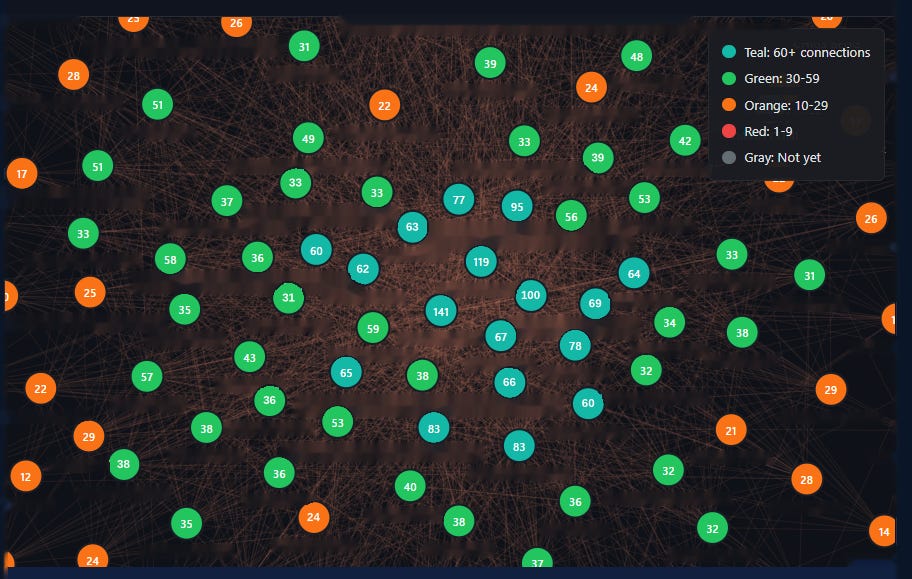
The average member has met 33 others (out of 150). That’s more than double what you’d see in most professional communities. Those meetings also only captured one interaction when, obviously, many members have become friends and met each other multiple times. Of all possible connections, 25% actually exist. For comparison, most professional networks have density under 5%. More than 20 members have reached 60+ connections; relationships with more than 40% of the community! You then hit a positive feedback loop as the most engaged people start making connections between each other at an accelerating rate.
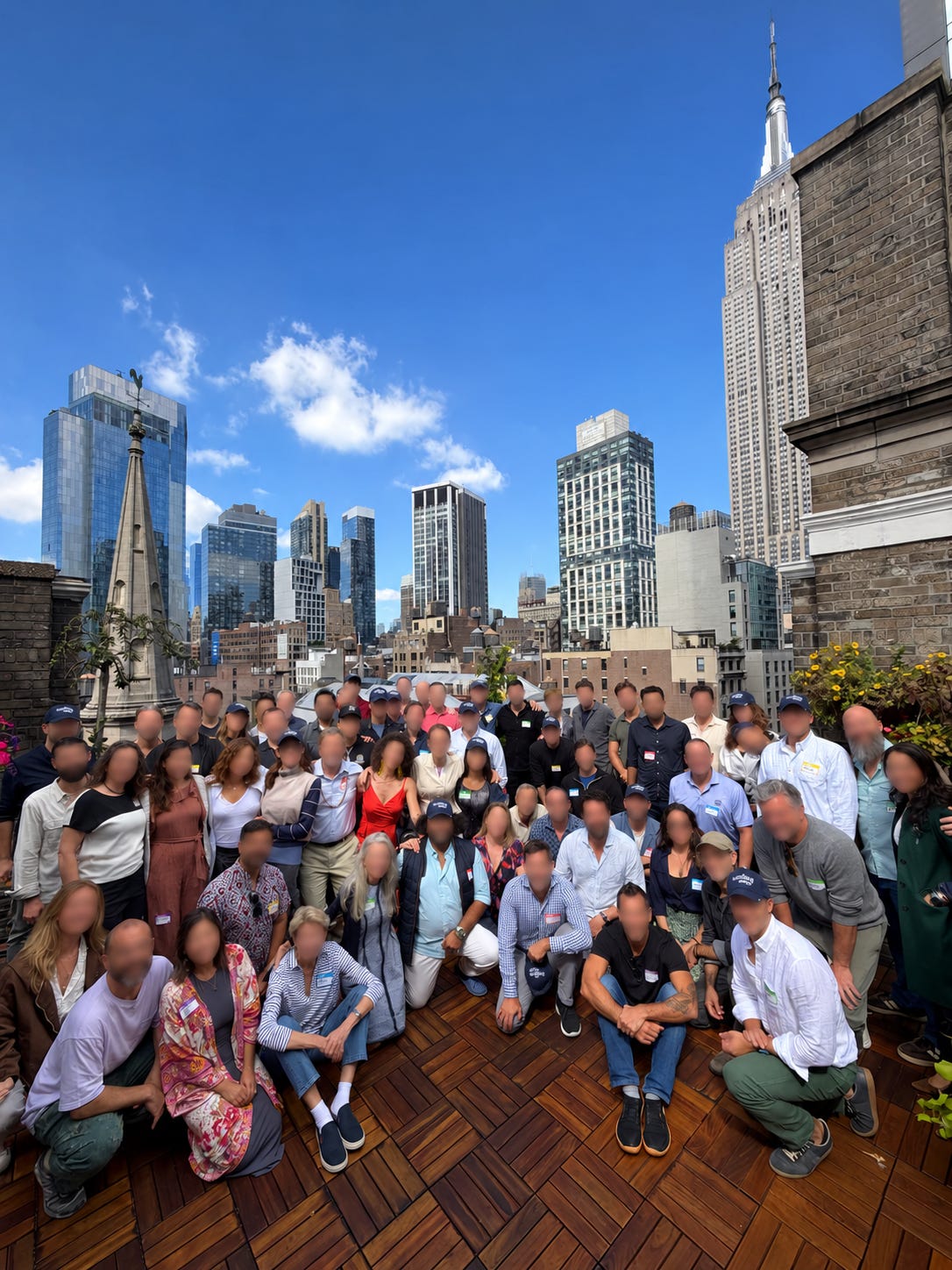
If you put enough different, curious people into sufficiently dense, trusting relationships surprising things start to happen. When people feel safe they are more comfortable putting their hard-earned money, time, and effort back into the group. We have now had a significant number of collaborations, from co-investments, to philanthropy to documentary production. I hope to tell you about them soon. Moreover, the most positive emergent outcomes have tended to correlate with who is the most engaged in the community.
I have genuinely never cried as many times in one day as I did at our recent New York Summit. The group felt safe enough to show themselves in full, in ways I could never have imagined. One of our most loving members, Bubba Grimsley, shared the story of his son Jack. Leading Edge helped support him during one of the worst things anyone could ever experience. Many of us agreed it was one of the most moving speeches we’d ever heard. In a remarkable act of generosity and bravery, he has decided to make it public for all of us to witness. [You can also listen on Apple Podcasts].
Bubba’s story not only describes how he was held in love through unimaginable pain, but also his process of being exposed to ever more mystery, and being changed by it in turn.
I can say with complete honesty that if this is the only thing Leading Edge ever achieves, it will have been enough for me.
Alien Language and Critical Yeast
Bubba’s agonising vulnerability led to him being transformed by something he couldn’t quite understand yet. You allow yourself to be changed by what you are attracted to, even if it hurts you in the process. Both authenticity and curiosity may depend on willingly opening to information and relationships beyond the boundaries of the present self. In a previous Leading Edge interview, Dr. Julia Mossbridge claimed that being in a mindset of unconditional love appears to enhance your performance in pre-cognitive tests.
In the weeks before our Summit, I was inexplicably drawn to rewatch the end of the movie Arrival (adapted from Ted Chiang’s Story of Your Life). In it, Amy Adams’ linguist Louise learns an alien language which allows her to see into the future. But in the process, she learns that the cost of foresight is knowing that she will have to endure exactly the same unbearable pain that Bubba did.
The central theme of the movie is explicitly that learning to connect with the minds of others is the solution to our zero-sum mindset1 and maybe even a window into what we are collectively becoming.

Love, curiosity, and future sense are inextricably connected to each other. Leading Edge-style containers can create that space. The Network of Networks is already up to more than 30 different communities. It’s obviously a great start. But each of these communities is necessarily limited to a couple of hundred people, and there are probably hundreds of thousands of people in the addressable market, if not millions. I’ve never seen a supply-demand mismatch like it in my life.
As far as I can see right now, the primary gating factor is the supply of network founders from the key professional centers of power. It returns me to a vision that I can’t stop thinking about. Imagine a physical campus that trains fifty stewards a quarter over a three month intensive. We bring together the best teachers and mentors in the world specifically on how to steward this kind of container. Those founders then return to Wall Street, Silicon Valley and the City of London. Possibly with a grant to get started (although you probably want founders who have already experienced some degree of material success). Each of them recruits 150 members from their high-agency tribes. Within a single year you’d theoretically have overlapping communities of 30,000 aligned individuals all networked together and sharing resources. The diverse groups can hopefully also challenge and regulate each other, ideally with oversight from a council of elders. A decentralized movement which nobody owns, powered by love and curiosity. But there is no guarantee the Network of Networks is going to succeed in the same way the individual communities will, perhaps unless the founders themselves can learn to love and trust each other. We will see.
I regularly hear people quote Thich Nhat Hanh’s “the next Buddha will be a Sangha (community),” but I have rarely heard them articulate why. Systems theorist Margaret Wheatley has a three-stage process where “networks” become “communities of practice” then “systems of influence.” The third stage describes “the sudden appearance of a system that has real power and influence. Pioneering efforts that hovered at the periphery suddenly become the norm. The practices developed by courageous communities become the accepted standard.”
The future may emerge first as faint signals sensed by unusual individuals; trusted communities allow those signals to be safely explored, relationships combine them into collective intelligence, and networks of those communities may eventually give society a way of adapting before change fully arrives.
Because this kind of phase shift is always unpredictable, you can only create the conditions that make it possible. Ben Katt recently wrote about how “mystic-catalysts” can produce “critical yeast.” This is when a group of loving, agentic people gathers together and makes strong connections. These connections form the prerequisite for phase shifts of sudden catalytic change. This is an entirely new energetic grid of information and positive-sum relationships that may become a foundation for whenever the next system emerges. A handful of the most intuitive people I know have shared similar visions with me. They each saw beacons of light springing up all over the world. I see it. If you do, come help us build a brighter future.
With China on the brink of attacking, Louise calls their General Shang and tells him his late wife’s dying words. He stands down his army. She only knows those words because, later in her life, Shang will tell them to her himself. Somehow, a deeper understanding of another person allows information from the future to change what happens in the present.
The physicist in the film calls the aliens’ offer to humanity a non-zero-sum game, the same phrase evolutionary author Robert Wright used for the force he believes drives humans toward cooperation at ever greater scales. When we truly understand other people, fighting them becomes absurd. In fact, I believe it can be the same force that drives us towards what we are curious about. I have long had the sense that certain beneficial future possibilities exert some kind of pull on our curiosity in the present, and people vary in their sensitivity to that pull. What, and who, we are attracted to evolves us.
This is why philosopher Tim Freke has argued that one of the most emergent capacities we have is “psysensing.” This is the ability to imagine and inhabit mental worlds, especially the minds of others. Earlier this year a group from Leading Edge travelled to Glastonbury, where we participated in a two-day workshop with him. The exercises enhanced our capacity to understand that the person opposite us is just like us and a totally unique soul. This is the complexifying force of differentiation and integration experienced directly: becoming more capable of perceiving uniqueness while still remaining deeply connected.
Instead of beacons of light, I see rings, like halos, low to the earth, held together by collective intelligences. Love the piece, Tom. Thanks for your work.
Interesting that you chose a community size of 150 - it is the Dunbar Number. According to researcher Robin Dunbar and many researchers he influenced, our brain size limits us to 150 connections, and his rule of 150 remains true for early hunter-gatherer societies as well as a surprising array of modern groupings: offices, communes, factories, residential campsites, military organisations, 11th Century English villages, even Christmas card lists. Exceed 150, and a network is unlikely to last long or cohere well. Lately social media might lead people to believe the rule of 150 has been obviated, but the majority of those excess connections are meaningless or even harmful. The 150 connections ratio limits how much complexity a social system can handle.