


One of the benefits of not being paid to produce content or chase engagement means I only release interviews when they are particularly interesting. As a result, this is the first interview I’ve published in more than six months (since our remarkable conversation with futures-trader-turned-Jungian-analyst Dan Lawrence).
This article and interview has a fun origin story. A couple of years ago, I encountered the LightEn project. It was created by the founder of British hedge fund TCI, Chris Hohn and his wife Kylie. They describe LightEn as “a growing global community dedicated to living the principles of consciousness through education, collaboration, and Service.” I was intrigued, because I’ve found depressingly few people of significant means willing to deploy their resources towards arguably the greatest leverage point there is: human consciousness.
The Library of Light section of their website grabbed my attention. It’s full of books off the beaten path, exploring figures who have deeply shaped The Leading Edge, like Dr. Chris Bache (our interview), Ervin László (our interview), and Daskalos.
One of Leading Edge’s members, Alex Carabi, was drawn to a book called The Marriage of Spirit by Leslie Temple-Thurston and Brad Laughlin. He recommended it to the group because it aligned with so many of our worldviews. I read the book and then reached out to Leslie and Brad. He let me know that tragically Leslie is experiencing memory loss and is fully retired, but he is continuing her work and legacy. He’s passionate about getting more mainstream recognition for the core practices in their book The Marriage of Spirit. As a result, he has just launched the MindYoga platform.
I went on to meet with Brad several times. When you listen to our conversation, you’ll be able to see why. I’m captivated by his gentle vibe matched to these powerful tools. My conversation with Brad specifically focuses on Brad and Leslie’s core practices of Witnessing, Polarities, Triangles and Squares [Listen on Apple Podcasts and Spotify].
Our conversation tells Brad and Leslie’s story in much more detail. Brad believes that she is authentically enlightened. Perhaps the most amusing part is that her enlightenment wasn’t achieved on a Tibetan mountaintop, but in a dingy Los Angeles apartment. After several weeks in meditation, she emerged with a very minimal ego structure. Almost immediately, strangers were drawn to meditate with her due to the powerful spiritual transmissions they received. Brad was one of those people.
Brad and Leslie describe their work as a way to accelerate your own spiritual growth. I rarely encounter tools that are safe, powerful, simple, and fast. They also emphasize it’s especially compatible with the frenetic Western lifestyle and cluttered mental landscape. The core philosophy also lines up neatly with Carl Jung’s idea of shadow work and “the transcendent function.” Jung has been hugely influential within Leading Edge, and shadow work comes up in so many spiritual traditions, yet I’ve always struggled to find practices for it that actually help in daily life. Brad and Leslie have a simple four-stage process.
1. Witnessing
The process starts with you bringing in your “witness”: the part of you that can observe thoughts without becoming them. It’s familiar to most mindfulness practitioners, and Brad has a short 3-minute meditation to get you into that state.
2. Polarities
This stage starts with you raising an emotional issue that you are currently dealing with. Brad coaches me live throughout our conversation, so you can see how this plays out in practice.
I chose to discuss my tendency to withdraw when stressed or criticised. I described all the emotions that I experience when I go into that state, and Brad wrote down a series of the most resonant words. We then went word by word and pulled out what we thought were the opposite sides of each emotion I was experiencing. When I am criticised, I dissociate, I feel worthless, hurt and defensive. So we decided good polarities would be dissociated/engaged, worthless/arrogant, hurt/healed, defensive/offensive.
As you do the process, you notice how each of the words lands emotionally. For me, there was a big charge between defensive and offensive (I didn’t ever want to be seen as offensive). And there was an even bigger charge between worthless and arrogant (being seen as arrogant was existentially dangerous in a British boarding school).
Here is the MindYoga 3-minute video guide to doing the practice yourself. I recommend you bring up something you’re really struggling with right now.
3. Triangles
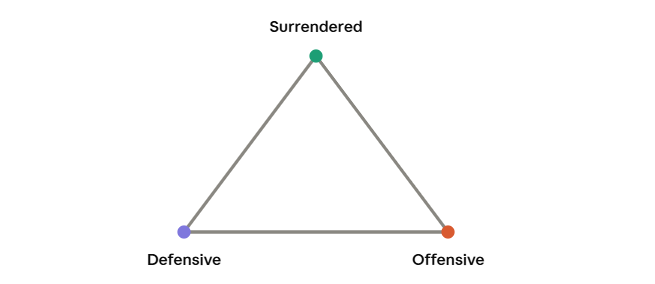
We took one of the charged polarities, feeling “offensive” and “defensive,” and did what Brad calls a Triangle. This is when you sit with the polarities and try and find an example that transcends both to produce what Brad calls a “heart word.” Examples would be compassion, generosity, gratitude, forgiveness or humility. Although these words often have literal opposites, heart words tend to have a different energetic quality to them.
After we sat with it for a bit, we realized that something that transcended being defensive or offensive was the sense of being surrendered. This doesn’t mean either giving up or forcing it, but achieving a state of effortless action.
Here is another 3 minute video to guide you through the practice yourself.
4. Squares:
For this slightly more sophisticated method, you don’t just pick two contrasting emotions, you also observe the underlying desire and fear on each side of the polarity. This makes your unconscious motivations, your shadow, conscious.
When doing your own squares, Brad suggests drawing quadrants and journaling within them around each heading. I confess that whenever anyone suggests that I take out a pen and paper to do something, I’m simply not going to do it. So, with Brad’s permission, I built a quick web app that lets you experiment with building squares. This is what the app looks like for this exercise. I recommend you try it now with any emotion or theme that’s dominant in your life.
Given the polarity of worthlessness and arrogance had so much charge, we split them out into a Square. You then have a fear of being worthless, a desire to be worthless, a fear of being arrogant, and a desire to be arrogant.
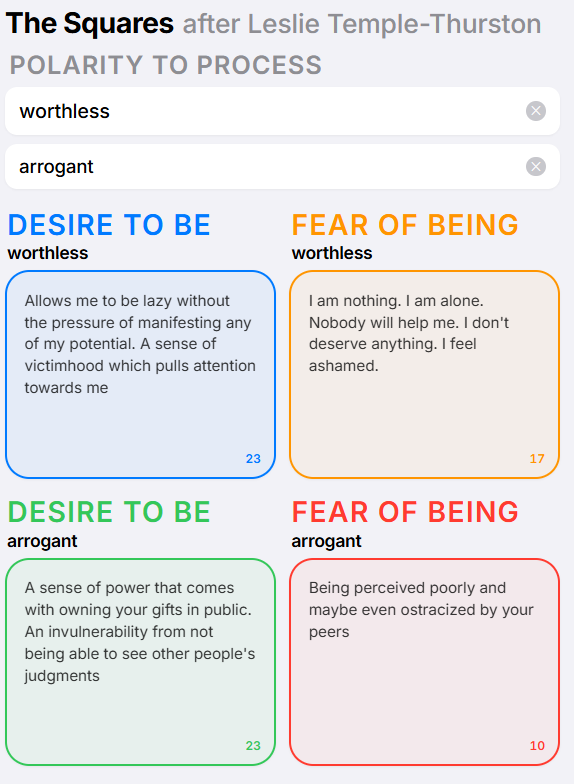
When we pulled them all together into a second triangle, the heart word that emerged between worthless and arrogant was authentic. Brad said that he also felt that the word humility resonated.
If it’s still not entirely clear how to do it, Brad also produced another 3 minute video explaining the practice. Brad likes to then close the whole process with a prayer, which you can hear in our conversation.
“All emotion is catalyst.”
There’s a line from The Law of One that I simply haven’t been able to stop thinking about since I read it a couple of years ago: “all emotion is catalyst.” There are some massive emotional events that would drive someone else absolutely crazy, but have no impact on you at all. There are other tiny tiggers that somehow absolutely floor you. When you reframe emotions as a catalyst for growth, it helps point you towards the lessons they are teaching you. However trivial the trigger, if you are experiencing a very strong emotional reaction, there’s always something for you to examine. The emotion is the proof.
What MindYoga does is reduce the intensity of the catalyst without emotionally dissociating you from it. The absence of an emotional charge around an event doesn’t mean you’ve abstracted yourself from life. It means that there are no more lessons to be learned from that experience, and so it’s unlikely to trouble you anymore. This obviously substantially increases your daily well-being. Even more than that, these tools help reveal that there is a always third, more enlightened path. For example, in a story pretty much all of us can relate to, Brad explained how the practices resolved one of the biggest blockers in his life: the role of money. One example of how this would play out would be that polarities of wealth and poverty are transcended by an overall sense of abundance. I hope you find these tools, and our conversation, as helpful as I have.
“The confrontation of the two positions generates a tension charged with energy and creates a living, third thing… a movement out of the suspension between opposites, a living birth that leads to a new level of being, a new situation.”
- Carl Jung, The Transcendent Function
[You can listen to our full conversation, on Apple and Spotify. Learn more about Brad and his work at MindYoga, as well as explore his exciting emerging community here].
Then write down two opposite sides of a dualism you are stuck rotating between. If you are feeling frantic and out of control, try and place yourself in the mindset of its opposite: settled and calm. If you allow yourself to sit in that polarity without trying to resolve to either side, you’ll notice a third feeling sometimes emerges. In this case, it’s a kind of faith and trust that is actually more than the combination of either being fully out of control or in control. This is consistent with what Carl Jung called the transcendent function.
There are other rexamples that I’ve found particularly helpful in my work. Between being skeptical and gullible is true discernment. A biggie is holding the tension between being selfless and selfish. The result can be a life in alignment “what you love in contribution to love.”